Our
Free Internet Libraries
Improve Grades
and Careers.
Index
Chapters 1 & 2 Questions for homework
Chapter 3 Questions for homework
Chapter 4 Questions for homework
Chapters 5, 6 & 7
Chapter 8 -10
Chapter 11
Chapters 12-15
Our Tutors
Available 24/7
Accounting
Career Services
Corporate Law
Economics
Employment Issues
Desktop Publishing
e-commerce
Graduate Education>
Industrial Products
International Business
Investment
Management
Marketing
Mathematics
Nursing
Physics
Programming
Secretarial-Services
Social Science
Statistics
Writing
Free Books
Textbooks-Business
Textbooks-Nonbusiness
e-books-Business
e-books-Classics
e-books- Modern Fiction
Collections-Subject
Computers Books-Business
Book Summaries
Self Improvement
Quick Notes Course Outlines
Solutions to Questions for homework
Chapters 1 & 2 Questions for homework
1. Make two statements about pollution, one demonstrating
Positive
Economics and
one demonstrating Normative Economics.
A. United States workers lose X hours per year because of illness caused by pollution.
B. No matter how much it costs, ten percent of the cars sold in Los Angeles should
be free of death-causing pollutants by the year 2000.
Files 2 Questions for homework
1. Give two examples of opportunity cost decisions you have had to make in your
personal
and/or work life. How did the law of increasing costs affect your decision?
A. Should you study or not study
B. Should you buy computer hardware or computer software
C. Students do not spend all of their time studying (or not studying) because at
some
point, the cost (loss of free time) is greater than the benefit (better grades).
2. Use the Production Possibility Frontier to depict full employment, unemployment,
and
slow versus rapid economic growth.
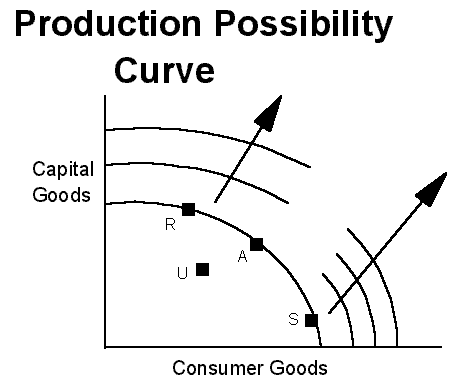
3. Using the Alternative Production Possibilities
data at the end of file 2, what was the opportunity A. The first high tech worker cost one entertainer. The second computer costs 2
entertainers.
cost of the first
high tech and the second computer? Why did the cost increase?
B. The skills required to make computers are not the same as those required to
entertain people.
The first person moving from entertainment work to making computers was good at making
computers
and a poor entertainer. The next people to moved were not as good at making computers
so it took two
people to produce an additional computer.
Test Prep Becoming a
Better Student
Review Materials
CLEP
SAT
ACT
GMAT
LSAT
NCLEX
TOEFL
Calculus AP Review
Economics AP Review
Psychology AP
Review
Statistics AP Review
Test Taking Help
Homework Help
Study Skills Help
Spelling, Grammar, Vocabulary
Improving Memory
Taking Better Notes
Self Improvement
Improving Behavior
Image Improvement
Etiquette and Manners
Gourmet Food & Wine
Home Based
Business
Stress Management
Self Motivation
Self Esteem
Learning Accessories
School Supplies
Student Accessories
Calculators
Electronic Books
Electronics Learning
Materials
Chapter 3 Questions for homework
1. Draw the circular flow of money.
Chapter 4 Questions for homework
1. Give examples of E and F that have happened in recent history.
A. Technological efficiency caused supply to increase more than demand in the 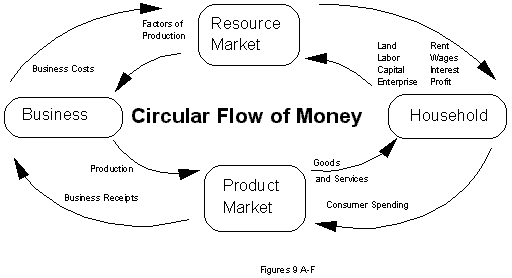
home
computer industry. As a result, prices decreased and quantity increased.
B. Two oil embargoes in the 1970's represented a large decrease in supply.
Demand
increases were small and the net effect was a small decrease in quantity
sold
and a large increase in price.
2. How would you expect government involvement in the market for college graduates A. The demand and supply for a college education has increased because of government
actions.
to
affect their market price? Has this happened?
This has increased the quantity of college graduates. During the 1970's,
price (the cost of
a college degree) increases were lower than inflation because
demand increased less than supply
increased. During the last 10-15 years, price has
increased faster than inflation. Demand has
thus been increasing faster than supply.
B. The increase in the supply of college graduates has caused the expected drop in their
wages,
but not to the extent that the drop in demand for high school and non-high
school graduates has lowered their wages.
3. Give examples of inferior and superior goods.
A. Inferior goods: bread, potatoes, beer
B. Superior goods: steak, vacations, expensive wine
4. T F Quantity demanded varies inversely with price, and quantity supplied varies
directly with price.
5. T F If the price of a good's complement goes down, the supply of the good will go up.
6. T F A price ceiling keeps prices artificially low, and the market reaction is normally
an increase in quantity supplied.
Support this site
by
shopping at
amazon.com
and
amazon.com
for students.
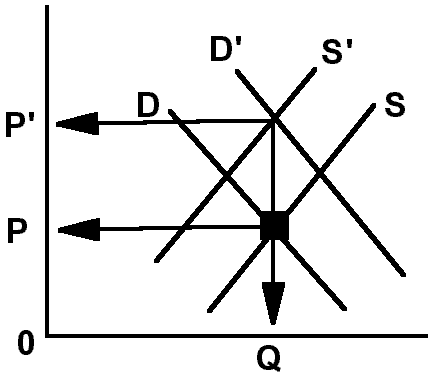
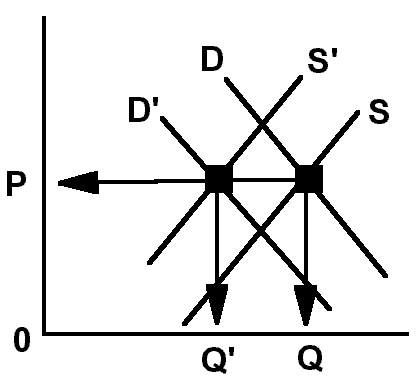
7. Demonstrate what happens to price and quantity for each of the four possible equal
changes in supply and demand.
D up and S up equally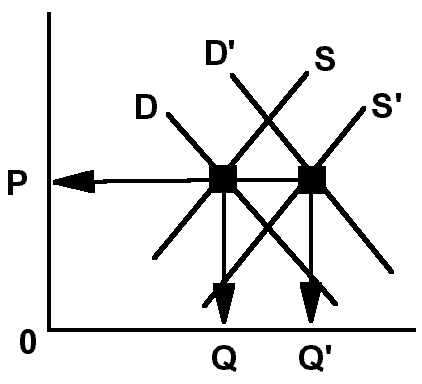 |
D up causes P up
and Q up S up causes P down and Q up Result is P same and Q up |
| D up and S down equally
|
D up causes P up
and Q up S down causes P up and Q down Result is P up and Q same |
D down and S up equally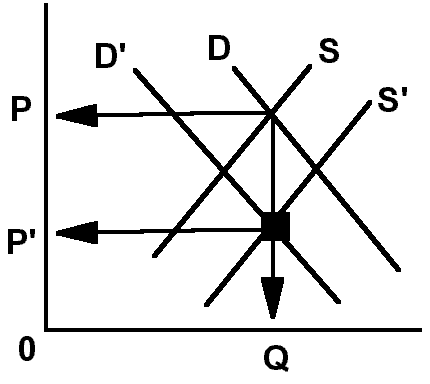 |
D down causes P down
and Q down S up causes P down and Q up Result is P down and Q same |
| D down and S down
|
D down causes P down
and Q down S down causes P up and Q down Result is P same and Q down |
Our
Free Internet Libraries
Improve Grades and Careers.
Support this site
by
shopping at
amazon.com
and
amazon.com
for students.