|
Our Expert Tutors |
Chapter 19 Elasticity of Demand To Print from an Internet browser, set type size to Smaller by choosing View, Text Size and Smaller, and choose File and Print. You may also need to set the margins to 0.25 inches. Return to Economics Notes Table of Contents E-mail antonw@ix.netcom with suggestions. Please Blog People About these Free Sites Using |
|
|
I. Special Notes A. Math Review is a short dynamic review of basic math skills for microeconomics from R. L. Reynolds of Boise St. University. B. Some may want to review supply and demand principles explained in Chapter 4. C. McConnell Economics Books, including the 18th edition, D. Our Current Events Internet Library has an interesting economics section. II. Elasticity of demand measures the responsiveness of quantity demanded to changes in price, income, and the price of related goods. |
||
|
III. Price elasticity of demand A. Price elasticity of demand measures the effect of price changes on quantity demanded. B. Sometimes a price increase causes quantity bought to decrease significantly, other times not so much. 1. High airfares for a luxury vacation may cause you to vacation locally. 2. High coffee prices for people who think of coffee as a necessity may not change quantity demanded very much. C. The more quantity changes because of a price change, the more elastic is demand. 1. Relative change will be measured as a one dollar change at higher prices is not as significant as at lower prices. 2. An easy way to measure relative change is to use percent change. D. Elasticity of demand is important because it predicts what may happen to total revenue received when a company changes the price of a product. E. Elasticity from Samuel L. Baker, Ph.D. of the University of South Carolina provides problems to help with the understanding of elasticity. F. Elasticity can be measured quantitatively. 1. The Coefficient of elasticity of demand for product x measures its price elasticity. 2. Delta, F. Elasticity can be measured quantitatively. 1. The Coefficient of elasticity of demand for product x measures its price elasticity. 2. Delta,
|
||
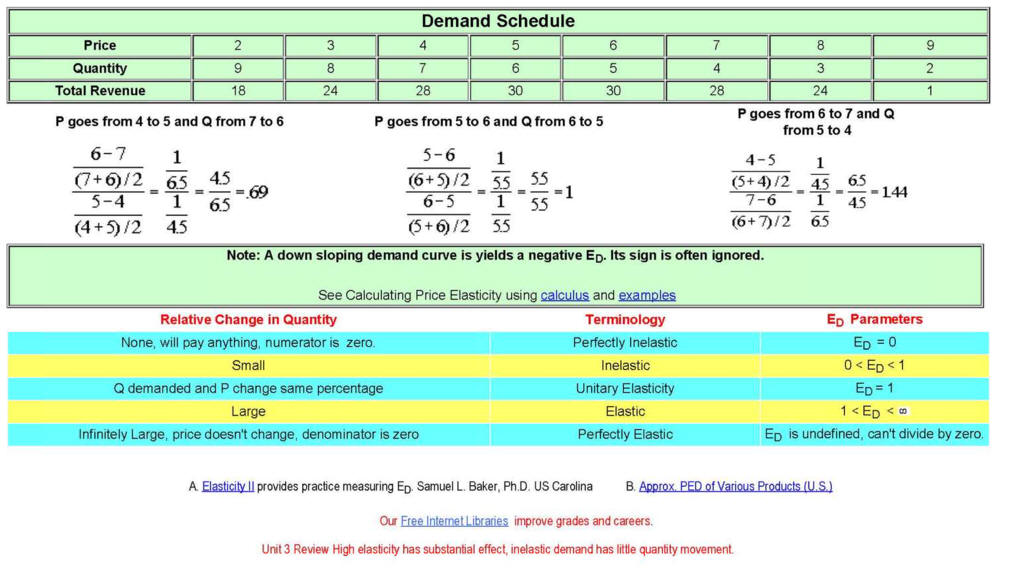
| G. A demand schedule has more than one elasticity of demand. | ||||||||
|
Demand Schedule |
||||||||
| Price | 2 | 3 | 4 | 5 | 6 | 7 | 8 | 9 |
| Quantity | 9 | 8 | 7 | 6 | 5 | 4 | 3 | 2 |
| Total Revenue | 18 | 24 | 28 | 30 | 30 | 28 | 24 | 1 |
|
P goes from 4 to 5 and Q from 7 to 6. |
P goes from 5 to 6 and Q from 6 to 5. |
P goes from 6 to 7 and Q from 5 to 4. |
|
Note: A down sloping demand curve is yields a negative ED. |
|
|
| H. Interpreting Elasticity of demand | ||
|
Relative Change in Quantity |
Terminology |
ED Parameters |
|
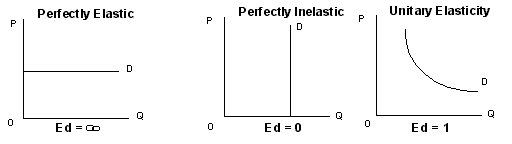
None, will pay anything, numerator is zero. |
Perfectly Inelastic |
ED = 0 |
|
Small |
Inelastic |
0 < ED < 1 |
|
Q demanded and P change same percentage |
Unitary Elasticity |
ED = 1 |
|
Large |
Elastic |
1 < ED < |
|
Infinitely Large, price doesn't change, denominator is zero |
Perfectly Elastic |
ED is undefined, can't divide by zero. |
|
1.
Virtual Economy
from
Buz\ed
has an elasticity calculator. |
||
IV. Graphing and Interpreting price elasticity of demand
| A. At the Extremes
|
30 Days to a More Powerful Brain
contains practical real-world applications of breakthrough discoveries
in science, psychology, and business. The material is structured so you
can learn quickly and apply it to any area of your life, no matter what
age you
These Notes are from
Macro and Microeconomics Quick Notes which are now Free at the
Economics
Internet Library. |
B. Total Revenue along a linear demand curve
![]() |
A. Moving from left to right on the bottom
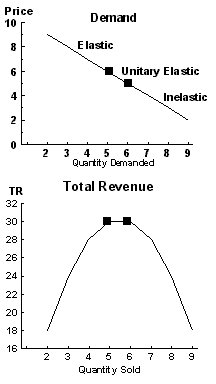
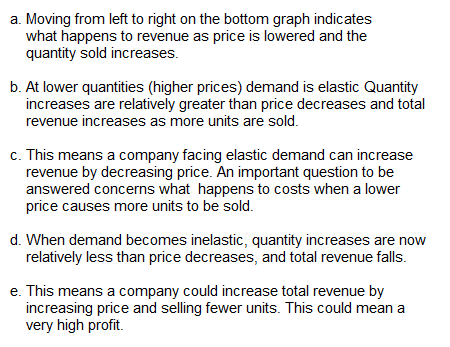
graph indicates what happens to total revenue as price is lowered and the quantity sold increases. B. At lower quantities (higher prices) demand is elastic. Quantity increases are relatively greater than price decreases and total revenue increases as more units are sold. C. This means a company facing an elastic demand can increase revenue by decreasing price. An important question to be answered concerns what happens to costs when a lower price causes more units to be sold. D. When demand becomes inelastic, quantity increases are now relatively less than price decreases, and total revenue falls. E. This means a company could increase total revenue by increasing price and selling fewer units. This could mean a very high profit. Important questions to be answered concern how competitors react to these higher prices, can the company produce lower quantities at reasonably low costs, exactly how much profit will the company make, and how will the government react to these higher profits. F. The Total Revenue Test 1. When demand is elastic, price and total revenue move in the opposite direction. 2. When demand is inelastic, price and total revenue move in the same direction. 3. Econ Concepts in 60 Seconds Video has a graphic explanation. |
|
||||||||||||||||||||||||
Please Blog Friends About This Free Library Using
V. What Determines Elasticity of Demand
| Product Characteristics | Elastic Demand | Inelastic Demand | Read Business Book Summaries to Save Time |
| Number of substitutes | Many | Few or none | |
| % of purchaser's budget | High | Low | |
| Type of good | Luxury | Necessity, Emergency | |
| Time until purchase | No hurry | Required quickly | |
| Examples | Steak, Vacations | Salt, Bread |
VI. Application
A. Various research methods are used
to calculate price elasticity:
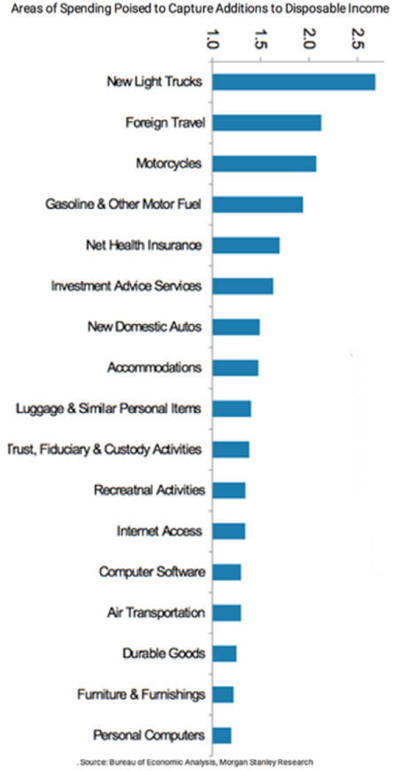
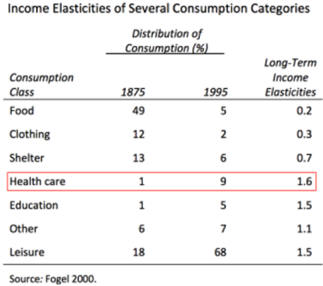
VII. Income elasticity of demand
is the % change in quantity demanded divided by the %
change in income.
A. Income elasticity is positive for normal (superior)
goods such as steak and vacations - more is
purchased as income
increases.
B. Income elasticity is negative for
inferior
goods such as bread and hamburger - less is purchased
as
income increases.
C. In times of recession,
income elasticity determines loss in revenue by producing firms.
D.
YouTube - Income Elasticity of Demand
E. Visit
Income
Elasticity of Demand from tutor2u for more information.
IX. Cross elasticity of demand is the % change in quantity demanded
divided by the % change in the price of a substitute or complement.
A. Cross elasticity is positive
for goods that are substitutes (price of hot dogs up,
quantity of hamburger sold up).
B. It is negative for goods
that are complements (price of hot dogs up, quantity of hot
dog rolls sold down).
C Near zero for independent
goods (peanuts and grapefruit)
C. Visit
Cross
Price Elasticity of Demand from tutor2u for more information.
X. Price elasticity of supply
is the % change in quantity supplied divided by the %
change in price.
A. It is a function of how factor costs
change as more is produced and the passage of time.
B. If costs (factor prices such as wages
and rent) change little as more is offered for sale at higher selling prices
then profit potential is high and supply will be
elastic.
C. Supply elasticity also increases with
time as companies have more time to adjust to higher costs.
1. Unusually high
demand for tomato's or the Chrysler PT Cruiser take time to produce and supply is
inelastic.
2. Gateway may be
able to increase the number of a new popular model computer quickly and supply
is more elastic.
D. Gold production is costly and takes time so
price is volatile because of frequent demand changes.
E. Visit
Price
Elasticity of
Supply
from tutor2u for more information.
XI. Economic Surplus of consumers and producers is explored in the next chapter.
Please Blog Friends About This Free Library Using
| Last Chapter |
|
|
| Chapter 19 Class Discussion Questions | ||
| Chapter 19 Homework Questions | ||
| Next Chapter | ||
| Table of Contents | ||
| Economics Internet Library |