|
Middle East
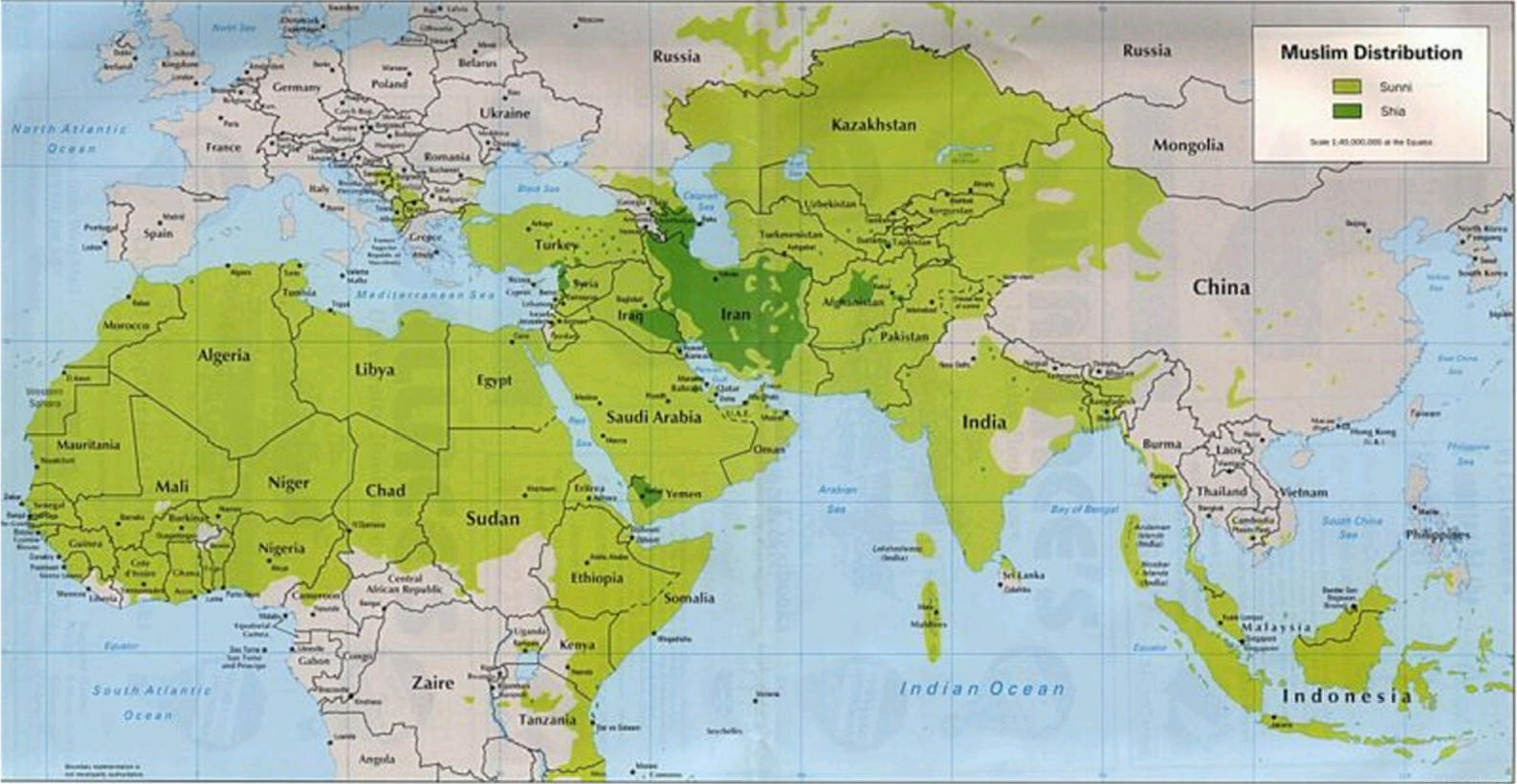
Religious Populations
USA Today 4/10/07 p 8A
*insignificant numbers |
Prelude from Back to the Ottomans, New depth
in an old split, page 17-18 of the Novermber 3 issue of The
Economist.
|
A little History
summarized from Back to the Ottomans, New
depth in an old split, page 17-18 of the November 3
issue of The Economist.
One internal argument between Sunnis and
Shias concerns an ancient disagreement over the primacy
of the many successors
of the Prophet. It has become deeper and enhanced by
sectarian killing in Iraq and worry over powers such as
Sunni Saudi Arabia and Shiite Iran.
A more complicated internal argument
concerns how Islam should adopt to the modern world.
Westerns like to split Muslims into
modernizers and traditionalists, but the later group is
very small. One strain of traditionalists pushed by
Wahhabi preachers and Saudi money feel Islam has been
corrupted by infidel ideas and must return to the Koran.
A second strain feel the Koran was given to
nomadic tribes and needs to be put into context. This
idea, which would the center of any Islamic
reformation, is still dominate at the great universities
of Cairo and Damascus. However, this strain has lost to
the Wahhabi strain of countless mosques and
Madrasah around the world.
Reformation counts for little in the
current Islamic world battle. Rather, it is a battle
between the martyrs and the traitors. The martyrs
believe the failures of Muslim countries has been caused
by moral dissoluteness and secularism. Relatively
incorrupt/democratic organizations like Hamas and the
Muslim Brotherhood provide strength in their battle to
center life around the Koran. Traitors are the deeply
undemocratic regimes often propped up by of Western
might and oil money. Some, like Egypt, use secularism as
the reason to suppress Islamists and
other, like Saudi Arabia, placate the radicals. |
|
Recent History
Summarized from
A Concise 20th Century History of Iraq
1) In 1979, the Sunnis Saddam Hussein assumed the office
of President of Shiite Iraq.
2) In the late 1970s, Iraq purchased a French nuclear reactor,
dubbed
Osirak or Tammuz 1.
3) Territorial disputes with Iran, a Shiites nation,
led to an inconclusive and costly 1980-88
Iran-Iraq War which
devastated the economy. The war left Iraq with the largest
military establishment in the Persian Gulf region but with huge
debts and an ongoing rebellion by Kurdish elements in the
northern mountains. The government suppressed the rebellion by
using (chemical?) weapons on civilian targets.
4) In
1990 Iraq
invaded Sunni Kuwait resulting in the
Gulf War which
was quickly lost.
5) After the war,
United Nations
economic sanctions
were imposed at the urging of
the United States.
6) During the latter part of the 1990s the UN considered
relaxing the sanctions imposed because of the hardships suffered
by ordinary Iraqis. According to UN estimates, between 500,000
and 1.2 million children died during the years of the sanctions.
The Unites States used its veto in the UN Security Council to
block the proposal to lift the sanctions because of the
continued failure of Iraq to verify disarmament. However, an
oil for food program was established
in 1996 to ease the effects of sanctions.
7) After the terrorist attacks by the group formed by the
multi-millionaire Sunni Saudi
Osama bin Laden
on the United States in 2001, American foreign policy
began to call for the removal of Iran's government.
In March 2003, the United States and the United Kingdom, with
military aid from other nations, invaded Iraq. |
|
Sunnis Jordan 92%
Saudi Arabia 90%
UAE 85%
Afghanistan 80%
Pakistan 77%
Syria 74%
Kuwait 70%
Yemen 70%
Iraq 35%
Lebanon 23%
|
Shiites *
10%
15%
19%
20%
16% Other Muslims
30%
30%
65%
38%
|
Other
<8%
*
*
1%
3%
10%
*
*
*
39%
|