|
Our Expert Tutors Can Help
With Difficult Assignments.
|
Chapter 4 Demand and
Supply and choose File and Print. You may also need to set the margins to 0.25 inches. When printing, highlight just the notes and choose File, Print, Selection, and OK. Our Economics Learning Center has information for students, teachers, an professionals. |
Please Visit Our Sponsors
Free Business
Book Summaries |
I. The
marketplace
A.
A market is defined as an institution or mechanism which promotes trade by
bringing together buyers
(demanders) and
sellers (suppliers).
B. Replaced barter which is the direct exchange
of goods.
C. A modern market brings money and prices into
the circular flow of goods.
II. Demand is willingness to buy.
A. Demand is a schedule of the amounts of goods and
services consumers are willing and able to buy at a set of prices.
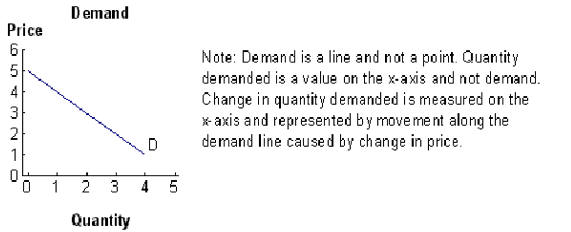
B. Law of demand:: price and quantity are
inversely
related.
1. As price goes up, quantity demanded goes down.
2. As price goes down, quantity demanded goes up.
3.
Why more is bought as price drops.
a.
Income Effect: as the price of a good drops, consumers feel richer and buy more.
b.
Substitution Effect: as the price of a good drops, it becomes cheaper relative
to
other goods and consumers buy more
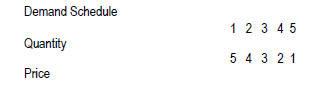
C. Demand schedule-Introduction to Graphs will provide tutoring for those needing help with graphs.
|
Price |
Quantity |
![]() |
|
|
|
D. What determines demand
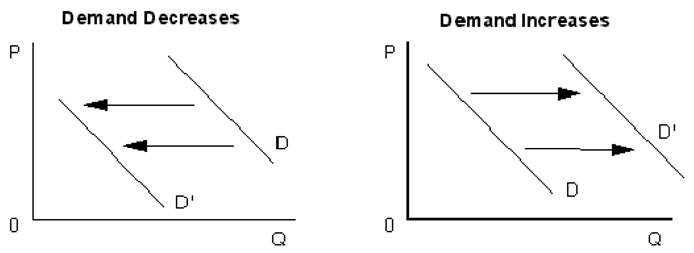
1. The tastes or preferences of consumers 2. The number of consumers 3. The incomes of consumers 4. Consumer expectations 5. The price of related goods a. Substitutes are goods that compete with each other such as hot dogs and hamburgers. If the price of a good increases, the demand for its substitutes will increase. b. Complements are goods that are purchased together like hot dogs and rolls. If the price of a good increases, the demand for its complement will decrease. 6. Demand analysis from Dr. Kim Sosin of the University of Omaha. 7. ''Ceteris Paribus'' is Latin for all other variables remain the same. E. Classification of consumer goods 1. Superior Goods: consumers buy more as income increases (steak, rolls, vacations) 2. Inferior Goods: consumers buy less as income increases (hamburger, bread, movies) F. Changes (shifts) in Demand 1. A decrease in demand shifts the demand curve to the left 2. An increase in demand shifts the demand curve to the right |
||||
![]() |
Note: Increase is to the right because the x-axis increases to the right. | |
| G.
Explorations
in Economic Demand by Kim Sosin, Department of Economics of the
University of Omaha has good examples. H. Check your knowledge of Demand by answering questions provided by Samuel L. Baker, Ph.D. of the University of South Carolina. |
||
|
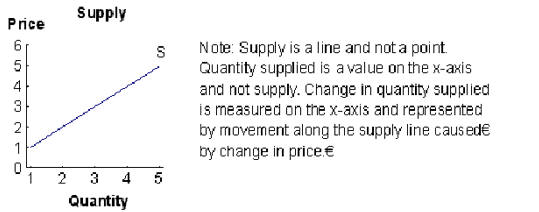
A. Supply is a schedule of the amounts of
goods or services producers are willing and able to sell at a set of prices. 2. As price goes down, quantity supplied goes down C. Supply schedule
|
||
|
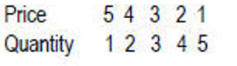
Price |
Quantity |
![]() |
|
D. What determines supply 1. Product costs as affected by a. Technology b. Resource prices c. Taxes and subsidies 2. Price of related goods a. If 2 goods are substitutes, price up for one will increase supply of the other (price of gasoline up, supply of alternative fuels increases) as companies see more potential profit b. If 2 goods are complements, price down of one will increase supply of other (price of PC's down, supply of computer software up) as the expected increase in sales of the first item should increase sales of the complement. 3. Expectations concerning the above listed variables will affect supply E. Changes (shifts) in supply 1. A decrease in supply shifts the supply curve to the left 2. An increase in supply shifts the supply curve to the right |
![]() |
Note: Increase is to the right because the x-axis increases to the right. |
|
| F. Explorations in Economic Supply from Dr. Kim Sosin of the University of Omaha has good examples. | ||
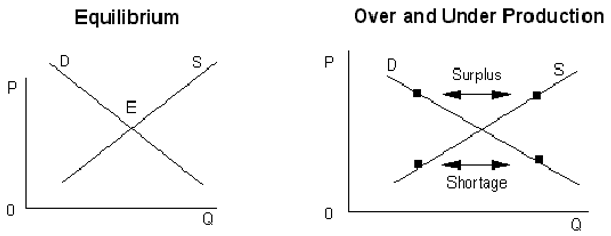
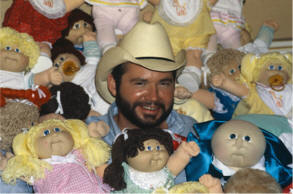
IV. Equilibrium is where suppliers and demanders agree on price and quantity as depicted by the intersection of their supply and demand curves. A. If the price is too high, a surplus results and price must be lowered (the world economic slowdown in 1999 required lowering price to work down supply) B. If the price is too low, a shortage results. This happens with toys every Christmas (Cabbage Patch Dolls) C. If they can not agree, as happened with Beta videotape machines, then the curves do not intersect and the goods are not sold. |
![]() |
|
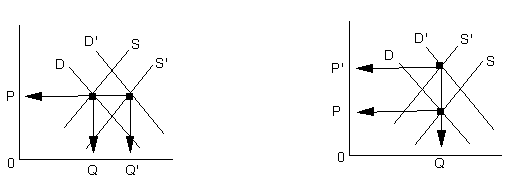
| D up and S up equally
D up causes P up
and Q up |
D up and S down equally
D up causes P up
and Q up |
|
![]() View a dynamic model of Changes in Supply, Demand and Market Equilibrium by Dennis Kaufman University of Wisconsin-Parkside. |
||
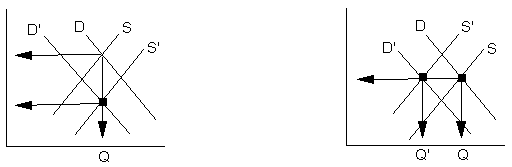
| D down and S up equally D down causes P down and Q down S up causes P down and Q up Result is P down and Q same |
D down and S down D down causes P down and Q down S down causes P up and Q down Result is P same and Q down |
|
![]() |
||
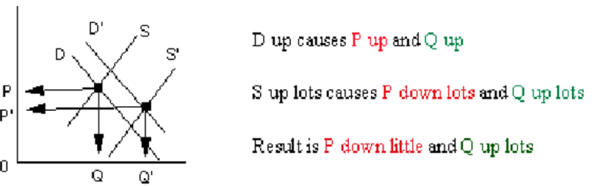
| D up and S up
more
|
||
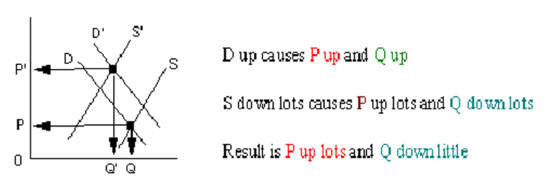
| D up and S down more
|
||
|
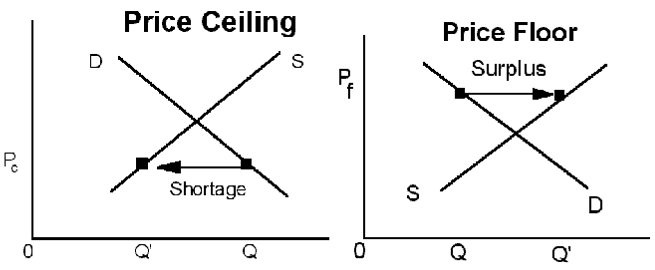
VI. Price ceilings and floors A. A price ceiling keeps prices from rising (rent control) B. A price floor keeps prices from falling (farm price supports)
|
|
|
![]() |
![]() |
| Last Chapter | Books |
| Chapter 4 Class Discussion Questions | |
| Chapter 4 Homework Questions | |
| Next Chapter | |
| Table of Contents | |
| Economics Internet Library |