

|
Our Expert Tutors Can Help
|
Chapter
26 Oligopoly
Please Blog Friends About This Free Library Using |
Please Visit Our Sponsors Free Sample of Statistics Using the Quick Notes Learning System. Free 5 Day Trial of Excel Tutorials |
|
Editors Notes:
A.
Part II Product and Factor Markets
should be read as an introduction to this
chapter,
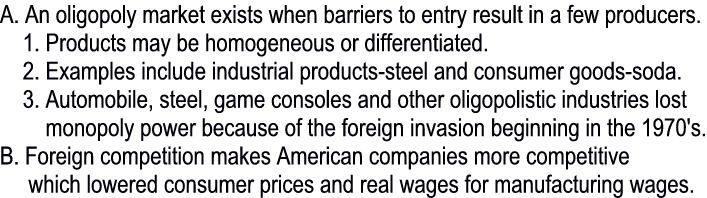
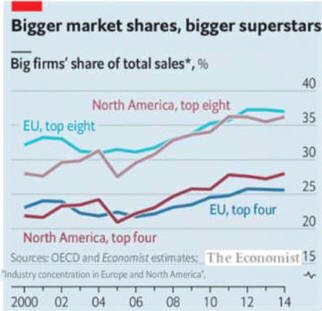
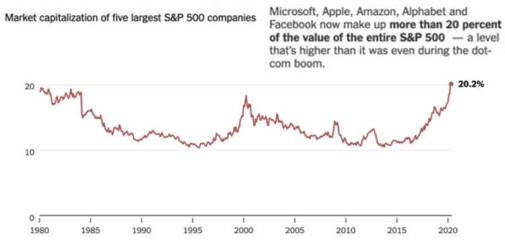
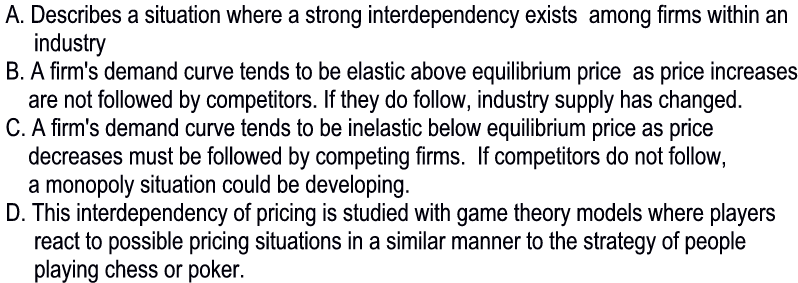
especially by those using I. Introduction A. An oligopoly market exists when barriers to entry result in a few mutually dependent companies controlling a substantial portion of a market. 1. Products may be homogeneous or differentiated. 2. Examples include many industrial products such as steel and large consumer durables such as appliances. 3. Automobile, steel, and other oligopolistic industries lost monopoly power because of the foreign invasion beginning in the 1970's. a. Eventually American companies became more competitive. b. The price was lower real wages for manufacturing workers. 4. Concentration ration measure the amount of total output controlled by a few firms. a. eight-firm concentration ratio - AmosWEB is Economics ... b. four-firm concentration ratio provides examples of possible oligopoly industries and companies. 5. Wikipedia provides the following on high concentration industries a. Six movie studios receive 90% of American film revenues. b. The television industry is mostly an oligopoly of five companies: Disney/ABC, CBS Corporation, NBC Universal, Time Warner, and News Corporation.[37] See Concentration of media ownership. c Four major music companies receive 80% of recording revenues. d. Four wireless providers control 89% of the cellular telephone market.[38] e. There are just six major book publishers. f. Healthcare insurance in the United States consists of very few insurance companies controlling major market share in most states. For example, Calfornia's insured population of 20 million is the most competitive in the nation and 44% of that market is dominated by two insurance companies, Anthem and Kaiser Permanante. [39] g. Anheuser-Busch and MillerCoors control about 80% of the beer industry.[40] B Three well-defined pricing models exist 1. Kinked demand 2. Collusive pricing 3. Price leadership Please Blog Friends About This Free Library Using II. Kinked demand F. Kinked demand curve theory from youtube G. Need more, try Kinked Demand from Amos Web. |
Our Expert Tutors Can Help
|
|
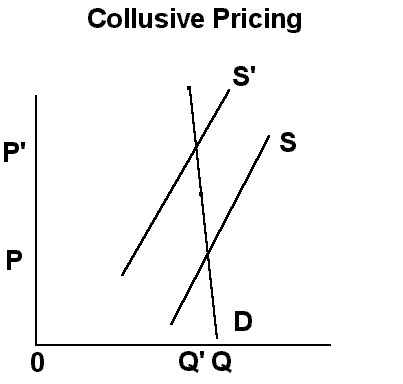
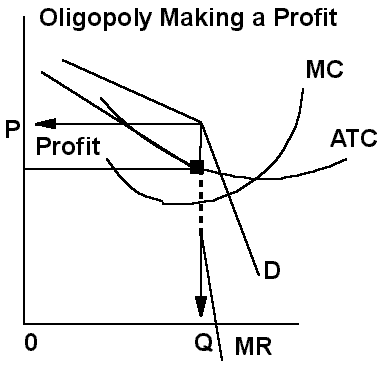
| F. Profit model | G. Collusive pricing is when a formal agreement (cartel) or informal agreement among competitors to restrict supply and benefit from the resulting high price (OPEC). |
|
|
|
|
III. Price leadership
I
V. Restrictive vs. progressive oligopolies V. Economic analysis of oligopoly
VII. Oligopoly theory makes heavy use of game theory to model the behavior of oligopolies:
A.
Econ Concepts in 60 Seconds
Video on Oligopolies and Game Theory
B. Advanced materials from Wikipedia
Read POWER ELITES & MONOPOLY POWER for a conservative view of monopoly power.
Based on this 50 minute
video, is our political system a monopoly, oligopoly, or purely
competitive?
Listen to
The Limits of Power Bill Moyers sits
down with history and international relations expert and former US Army
Colonel Andrew J. Bacevich who identifies three major problems facing our
democracy: the crises of economy, government and militarism, and calls for a
redefinition of the American way of life.
| Last Chapter |
|
Please Visit Our Sponsors Accounting for Non-Accountants is a self passed Internet course. Free Sample of Statistics Using the Quick Notes Learning System. Free 5 Day Trial of Excel Tutorials
|
|
| Chapter 26 Class Discussion Questions | |||
| Chapter 26 Homework Questions | |||
| Next Chapter | |||
| Table of Contents | |||
| Economics Internet Library |
|
Academic Stores |
Free Internet Libraries |
||
|
Free General Libraries
Free Computer Libraries |
Mathematics Related Libraries |
Special Interest Libraries |
|
