



 The Indians
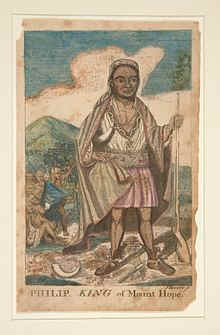
were led by Massasoit's son Metacom. Called King Philip
because of his European dress and custom, he put up a good fight. But the
Colonies had superior numbers plus 500 Mohegan Indians who were blood
rivals of the Wampanoag. Devastating battle tactics that included a return
to wholesale massacre of noncombatants followed.
The Indians
were led by Massasoit's son Metacom. Called King Philip
because of his European dress and custom, he put up a good fight. But the
Colonies had superior numbers plus 500 Mohegan Indians who were blood
rivals of the Wampanoag. Devastating battle tactics that included a return
to wholesale massacre of noncombatants followed. 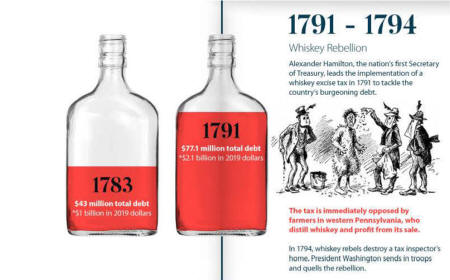
















In July 1958, Ike sent 15,000 Marines
and soldiers to
Lebanon as part of
Operation Blue Bat, bring regional stability,
weakened Soviet influence, intimidated the Egyptian and
Syrian.
|
|
|
 Prelude: Who Discovered America First? 14 min video
|
|
|
American Culture By 1492, there were about ten million First Americans divided into hundreds of Indians tribal societies. The most advanced were the Mayans and Aztecs in Mexico and the Incas in Peru. To the north were the Eskimo and Inuit cultures. None developed the advancements in agriculture, mathematics, architecture, and other fields that were achieved in Europe and the East.
Religion Freedom Began in 1636
Editor's comments in red. |
Politics "After the great split from the Roman Catholic Church that created the Church of England, the question of religious reform continued heatedly in England. Feeling the Church of England was too ' "popish" ' some wanted to be further away from Rome, to ' "purify it" ' and they were called Puritan. Separatists felt the Church of England was too corrupt and wanted autonomy, to separate from the Anglican church. Thought too radical, they were treated as they would be today, forced out of England or underground. Some Separatists, now called Pilgrims, went to Leyden, Holland where they were accepted. But cut off from their English traditions, they decided to relocate to America. Fifty-five Pilgrims were among the 102 men, women and children who were aboard the small ship Mayflower that landed on the now famous, and very small thanks to people taking souvenirs, Plymouth rock. Puritans called themselves ' "Saints" ' or ' "First Comers.&quo ' |
|
War Recent estimates of Indian numbers living in the Americas before the Europeans arrived are very high, perhaps 100 million spread over the two continents. The European destruction of these peoples was ruthless though disease caused the majority of 90 percent killed. The unintended consequences of progress, civilization, and Christianity were immense. See The Great Small Pox Epidemic of 1617 11 min video |
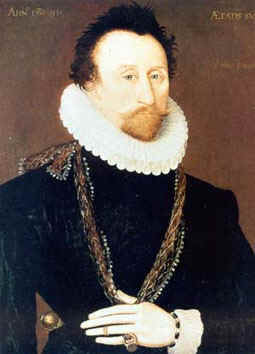
Race Relations Slave trade in the Americas began when English naval commander John Hawkins began direct trade between Guinea and the West Indies. By 1600 the Dutch and French had caught up and by the time slaves arrived in Jamestown, a million or more black slaves had been brought to the Caribbean and South America.
5-times-hurricanes-changed-histor
|
|
Early Colonial Period
|
|
|
Current Issue 1:
|
|
American Culture
Twenty mostly women died in the 1692-93 Salem witch trials. The cause was the common place religious infighting of the day. People wanting there own church formed Salem Village in 1672. Several years of haggling over ministers followed but 1689 brought Harvard dropout Samuel Parris. He failed to calm the troubled parish. In January of 1692 the minister's nine and twelve aged daughters began acting strangely. So did the twelve-year-old Ann Putnam. She was daughter of the town's most powerful men. . The doctors diagnosis they were bewitched and under an "Evil Hand." Suspicion immediately fell on the Paris family's slave who had been teaching the girls fortune telling games. She was arrested along with two elderly townswomen. They were jailed for witchcraft. The trail caused an astonishing wave of accusations and the three young girls, basking in all the attention, ignited a storm of satanic fear throughout the Massachusetts Bay Colony. The trial was like something out of Alice in Wonderland. Twenty-eight people, mostly women, were convicted. Five confessed and were spared, two escaped and a pregnant women was pardoned. Nineteen were hung and the husband of one died by stoning when he refused to confess. Some blame ergot, a fungus that affect rye grain and the substance from which LSD is derived for the girls strange behavior.
Culture of
Current
US Tax System
|
Politics
Traditional view that the Revolution was
fought for liberties Americans felt as English citizens they already
possessed. This should be merged with the political and economic view that
the war was fought to transfer power from a British elite to a homegrown
American
power
class.
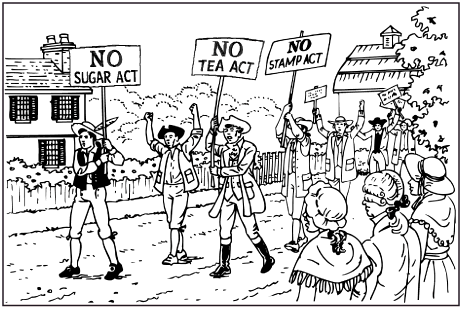
video Needing money to pay for the Seven Years War with France, Parliament passed what it thought a entirely reasonable 1764 Sugar Act. It put a tariff on sugar, coffee, wine and other imports into America. The colonies, were in recession which is usually the case after high wartime spending. They responded negatively with the resulting political slogan "No Taxation Without Representation."
Politicians were looking for more than a few seats in Parliament Wanted to drive a wedge between Mother England and the Colonies, they were seeking a larger prize. Resistance to the sugar tax was negligible until a second 1765 Stamp Act put a stiff tariff on all printed matter from newspapers and legal documents to playing cards. This was not a tax on trade but a direct tax and America protests grew louder and more violent. In Boston the house of British Governor Thomas Henderson was destroyed by an angry mob. In New York the home of the officer in charge of the Stamp Act was ransacked. This time boycotts were successful and the act was repealed. |
|
War
The French and Indian War of 1756-63 also
called the Seven Years War was the biggest and last of four
wars fought in North America by European powers. They were fought for territory, raw
materials, and new export markets.
A young George Washington was sent by Virginia's Governor to tell the French they were trespassing. Upon learning they hid no plans to leave the territory he returned, made a report, was commissioned, and wrote a small book entitled The Journal of Major George Washington. He returned with a 150 man militia to build a fort. Surrounded by the French, he surrendered and was sent packing back to Virginia where he was a hero for taking on England's chief rival. `A number of battles were fought with
the French. Helped by Indians who wanted to repay many years of English
treachery, the French won early battles. Eventually England and her
colonies won. The spoils of war consisted of control of Canada, America
east of the Mississippi, Florida and some Caribbean Islands.
Indian
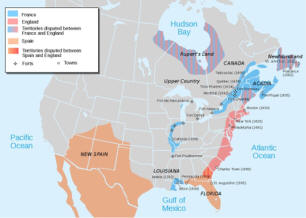
Wars: A History 1750 possessions of Britain (pink), France (blue), and Spain (orange) in contemporary Canada and the United States. King George III Set Aside a Massive Reserve for Native Americans—Then Came the Revolution
|
Race Relations Following the 1643 murder of a Dutch farmer New Amsterdam's Governor ordered friendly Wappinger tribe that had come seeking shelter massacred. Eight Indians were killed while sleeping. Their heads cut off and placed on poles in Manhattan. "A Dutch lady kicked the heads down the street." The first of two New England Indian wars was against the Pequot, a powerful Mohican clan felt to be a threat. Urged in 1637 by Boston preachers and using trumped-up murder charges, Puritans declared war and sacked and burned villages. They then used Narragansett and Mohegan Indians to enter the stockade of Pequot and slaughter 600 inhabitants. The men were killed, the boys sold into slavery, and the girls and women became Puritan slaves. The summer of 1676 saw the second battle. It was against Massasoit's Wampanoag survivors of the Pilgrims massacre and the Narragansett who were led by Canpnicus. He had sheltered Roger Williams who had been banished from Boston because he wanted religious freedom.
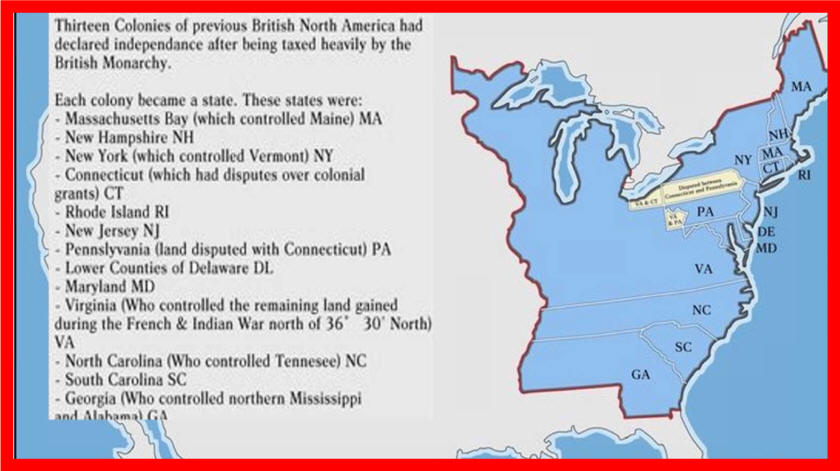
After these two wars the English were ready for the subjugation of New England. See The 1676 King Philips War Began Two Centuries of Indian Removal. Ages of the
Founding Fathers on July
4, 1776 |
|
Current
Issue 2
Historical and
|
More Info
2
See Our Democratic Federalist Republic
From Presidential Courage Please Use to Educate and Share. |
|
|
|
3
Growing
a Nation: |
|||
|
American Culture |
Politics |
War |
Race Relations |
|
The Revolutionary
War brought prosperity as business prospered, soldiers spent, factories turn out ships
and supplies.
But victory brought inflation and depression. Bloodshed between Americans
resulted as economic tension between two sides. On one was frontier farmers,
inner-city laborers, the servant class, smaller merchants, and free
blacks. On the other side were the haves consisting of landed
slave holding gentry and the international city merchants. A 1780 Massachusetts state constitution was not liked by the working people and many veterans who had not received their federal bonus. As the economy worsened farmers were seized to pay off debts and when called, the militia sided with the angry farmers. In 1786, seven hundred farmers guided by Daniel Shays marched on the Springfield Massachusetts Armory. The Riot Act which allowed jail without a trial quickly passed. Then a thousand man army marched on Boston, the seat of wealth and power. Casualties on both sides resulted, but a cold winter disbanded the army. But the civil disobedience of Shay's' Rebellion brought an end to the state's direct taxation, reduced farmer court costs and an exemption of workman's tools and household necessities from the debt process.
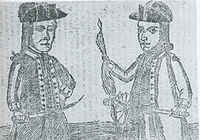
Daniel Shays and Job Shattuck, the two main rebels. See Turning Points in American History Shay's Tax Rebellion Leads to a National Constitution
|
Napoleon Bonaparte engineered
a coup that overturned the Revolutionary
Directory that governed after the French Revolution. He eventually
became ruler of France. President Jefferson's offered to buy New Orleans
from France. Napoli offered a larger area because needed money to finance
a big army and he didn't want the cost of managing a far away territory. The
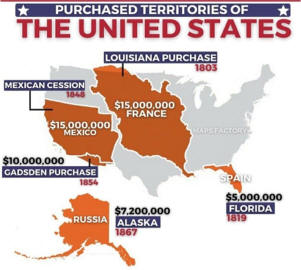
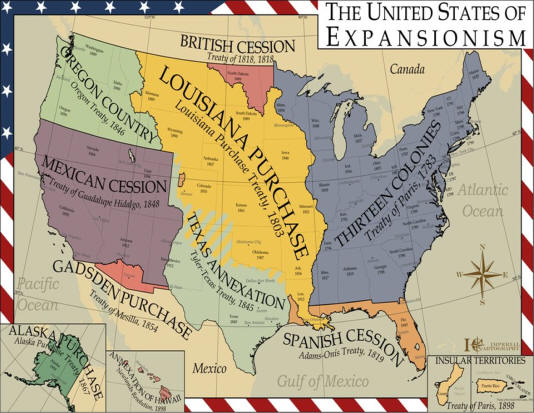
1803 Louisiana
Purchase resulted. It doubled the size of the United States and
was soon explored by Lewis
and Clark.
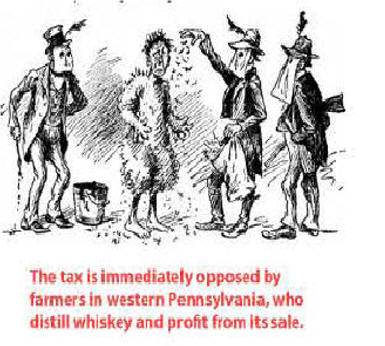
Click to enlarge. President Jefferson had cut Whiskey Tax that had defended and he also sent the Navy to fight Barbary pirates off North Africa. Both very popular and he easily won the 1804 reelection.
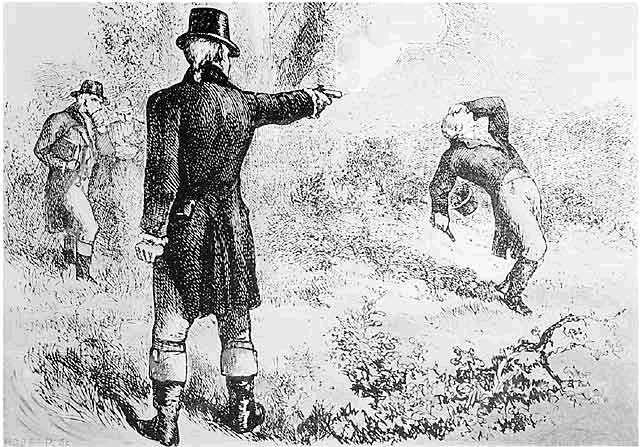
See the GEORGE WASHINGTON section of Presidential Courage and Meacham's Thomas Jefferson PART VIII. The Federalist Party was on its last legs, decided to support Aaron Burr's run for New York Governor. His bitter enemy Alexander Hamilton did all he could to stop Burr who he thought a "dangerous man." Besides political attacks Hamilton, himself an admitted adulterer, went after Burr's notorious sexual exploits. Burr lost and not real happy with Hamilton, eventually challenged him to a dual. Hamilton's son had died in a dual and he was against them but he felt the Federalist Party honor was at stake. Hamilton missed. Burr did not.
|
The War of 1812 came
about because President Madison was pushed into action by Kentucky's Henry
Clay. Clay was upset because the English impressments of sailors taken from
American ships. They also encouraged Indian unrest.
The English fought a reluctant war as she was preoccupied with continental armies of Napoleon. English commercial interest wanted American markets and suppliers that were disrupted by the war. See
Constitution defeats HMS Guerriere, a significant event during the war. Click to enlarge. The two plus year war ended with America's only victory at the Battle of New Orleans which happened after the war had ended.
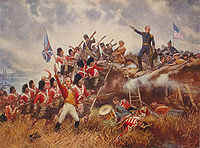
General Andrew Jackson stands on the parapet of his makeshift defenses as his troops repulse attacking Highlanders as imagined in 1910 by painter Edward Percy Moran. See
Presidential
Courage
|
The
history of European relations with native Americans encountered in the new world is a story of endless
betrayals, butchery, and broken promises. From the beginning with Columbus
and the conquistadors; the Euro-American strategy created a genocidal
tragedy that surely ranks with the cruelest episodes in man's history.
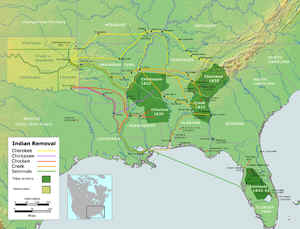
There were five civilized Indian tribes that were compatible with white culture and even copied some European styles. The Choctaw, Chickasaw, Creek, Cherokee, and Seminole tribes had built roads, schools, churches and had became farmers and cattle ranches.
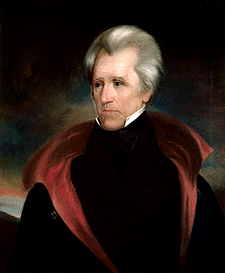
Painting (1805) of Benjamin Hawkins on his plantation, instructing Muscogee Creek about European technology Click for an enlarged slide show. Because of Andrew Jackson, America's attitude went from anti-Indian sentiment with sporadic regional battles to the convenient federal removal policy. The Creek War of 1814 ended quickly. Commanding the Tennessee militia, Andrew Jackson used Cherokee Indians who were promised government friendship. They attacked the Creek from the rear. As treaty commissioner, Jackson managed to take away half the Creek lands much of which he and his friends bought on attractive terms. He wrecked similar illegal havoc against Seminoles in Spanish Florida. Georgian Cherokees owned valuable land so over 15,000 were forced in 1838 to leave their homes march to Oklahoma. About 4,000 died. The Indians called the forced march Trail of Tears.
For more on A. Jackson see
ANDREW JACKSON took on eastern bankers and vetoed the charter
extension of the Second Bank of the United States because he felt it had
excessive power over farmers. From Presidential Courage. See A Concise History of U.S. Immigration
|
|
Building America's Democratic Federalist Republic
A hurricane Helped Alexander Hamilton |
|||
|
Current Issue 3: Conservatism vs. Progressivism |
|
American Culture |
Foreign Affairs/Politics |
War |
Race Relations |
||||
|
In the seventy-two years between the
inaugurations of Washington and Lincoln a sparsely populates two hundred
mile-wide third-rate republic threatened by foreign powers and dangerous
Indian tribes changed. It had become a pulsing, burgeoning economic power stretching
across the continent.
Canales were being built, first generation steamships carried prospectors around then Cape Horn to California, railroads and the telegraph were beginning to link ever growing cities, the horse-drawn reaper was improving agriculture, and the sewing machine and the Colt revolver was the talk of Europe. Enhanced by the Irish famine, immigration increased dramatically. By 1860 one-eighth of America's 32 million people were foreign born. The slave-based agrarian economy with its gentlemen farmer described so well by Margaret Mitchell's Gone With The Wind was very different from the rushing into modernity Northern states. |
James
Polk won the 1844 Manifest Destiny
election over the future of the Oregon Territory and annexation of
Texas.
|
Independence,
foreign provocation, and global politics had caused early U.S. Wars. The Mexican War
was for territorial expansion. Young Lieutenant, Ulysses
S. G rant, said the war was "one of the most unjust ever waged
by a stronger against a weaker nation."
Polk sent General Zachary Taylor looking for trouble far into Mexico. He stopped at the Rio Grand River and when a U.S. soldier was found dead and a patrol attacked by some Mexicans, Polk announced " War Exists." The Democratic congress quickly voted for war and 50,000 army troops.
America's Unfinished Revolution
|
Amistad Slave Rebellion
Click to enlarge.
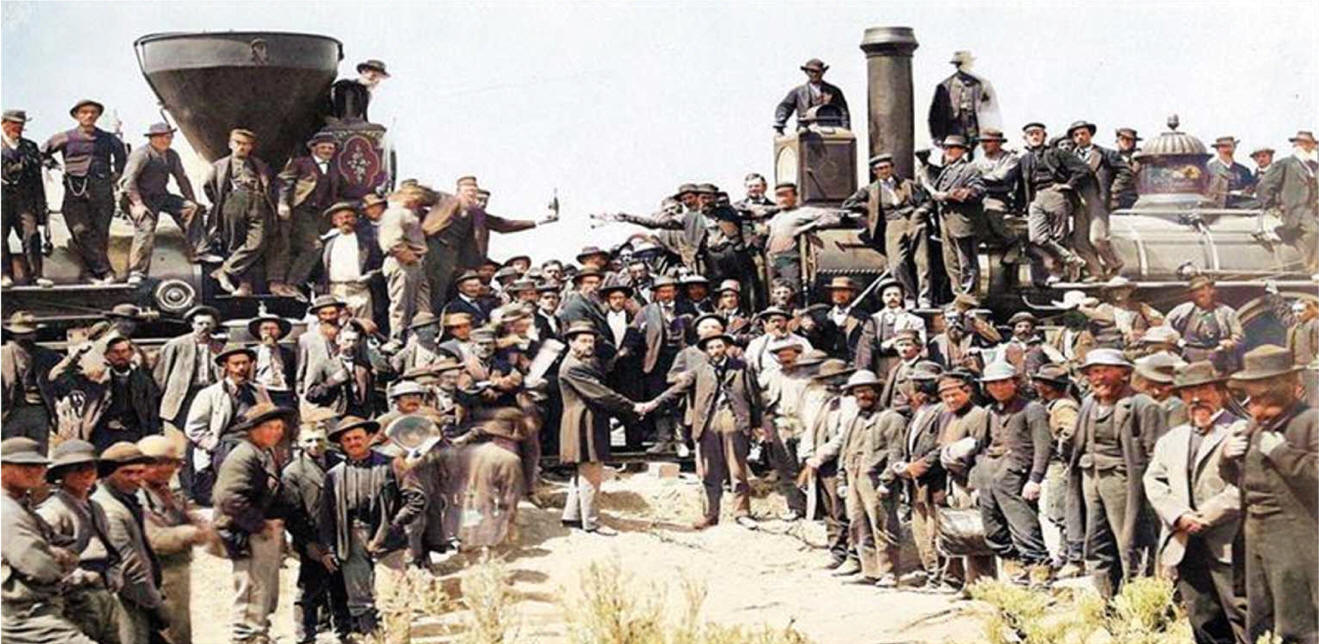
East Meets West-Transcontinental Railroad 1869/8
| ||||
|
|
|
Current Issue 4 Turning Points in American History On Grand Strategy Political Economy Biographies Presidential Courage Thomas Jefferson American Dynasty Second Chance
Please Use to Educate and
Share. |
|
American Culture |
Foreign Affairs/Politics |
War |
Big Business |
|
In thirty-five years
after the Civil War to the twentieth century America moved with astonishing
speed through Reconstruction and being nation of
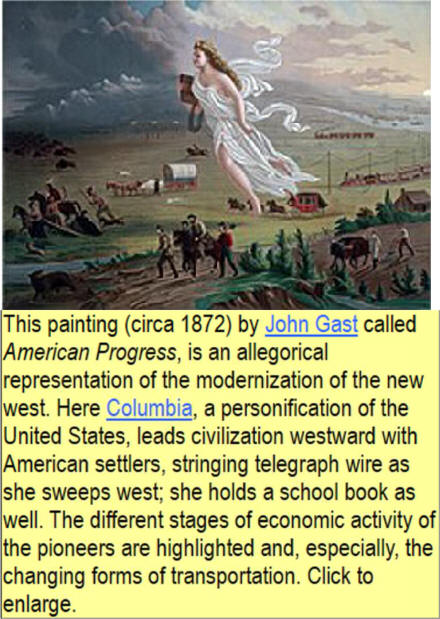
farmers to an industrial empire holding far- flung possessions. Railroads,
steel and oil were the engine. But as Mark Twain and Charles Warner pointed
out in The Gilded Age that the cost was many
workers died. There was astonishing corruption and the outlaws of the Wild
West were small-time compared to the politicians of the east who
brazenly stole millions.
New York police violently attacking unemployed workers in Tompkins Square Park, 1874.Click to enlarge.
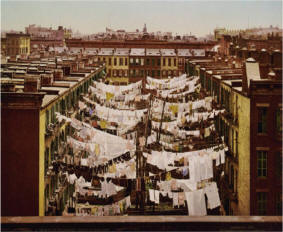
Washing day in New York City, 1900. |
The founding fathers had
envisioned a government by an enlighten aristocracy comprising of gentlemen
of leisure and education. They got a government in the government in the pockets of
the powerful and wealthy industrial and banking magnates. They literally
owned the government and turned it into an instrument to enhance their
personal wealth. Postwar presidents were either weak, inept, or corrupt and had
little chance against industrial giants like Morgan, Gould, Rockefeller and
Carnegie. Teddy Roosevelt began the process fighting big business wealth and
corruption. Click
How to Hide an Empire video
|
Indians had lost there
hunting grounds to the War of 1812, Manifest Destiny, the Mexican War, the
California and Colorado gold rushes and industrialization. There were about 300,000
Indians left in the
entire West and their last battle in the twenty-five years assault
against them by the U.S. Army was at the
Battle
of the Little Bighorn. General Custer and 250 soldiers ignored warning that between 2,000 and 4,000 Cheyenne and
Sioux await them with a 1876 frontal attack. The disagreement was again caused by a desire for gold and
only the slaughter of U.S. Army soldiers was reported back East. See
Mexican-American War 1846-48
17 min
and
Spanish-American War 1898
12 min
Bloody Knife Click to 4.
Philippine–American War |
"This was an era when
political genius took a back seat to a genius expressed in accumulating and
holding more private wealth and power than had been possessed in history."
J.P. Morgan refused to loan the U.S. Government money because it lacked
collateral and when he did loan them money, he promptly sold it at a
enormous profit. America's wealth had always been controlled by a minority
but at this wealth concentration was brought to an entirely new level.
Building railroads was the source of wealth as the federal government provided the land, immigrants on both coasts provided the labor, Andrew Carnegie the provided steel, and J.P. Morgan Sr. and Jr. provided the cash. Many millions were made in assorted railroad building scandals but this was small change compared to the fortunes being made by the so-called robber barons, a term coined by historian Charles Francis Adams in his 1878 book on Railroads: The Origins and Problems. The Bosses of the Senate", a cartoon by Joseph Keppler depicting corporate interests–from steel, copper, oil, iron, sugar, tin, and coal to paper bags, envelopes, and salt–as giant money bags looming over the tiny senators at their desks in the Chamber of the United States Senate. Click to enlarge.
|
|
More Info 5
Growing a Nation |
|||
|
|
Part 2 Becoming "the" World's
Leader |
|
|
|
Crowd at New York's American Union Bank
See Market Bubbles
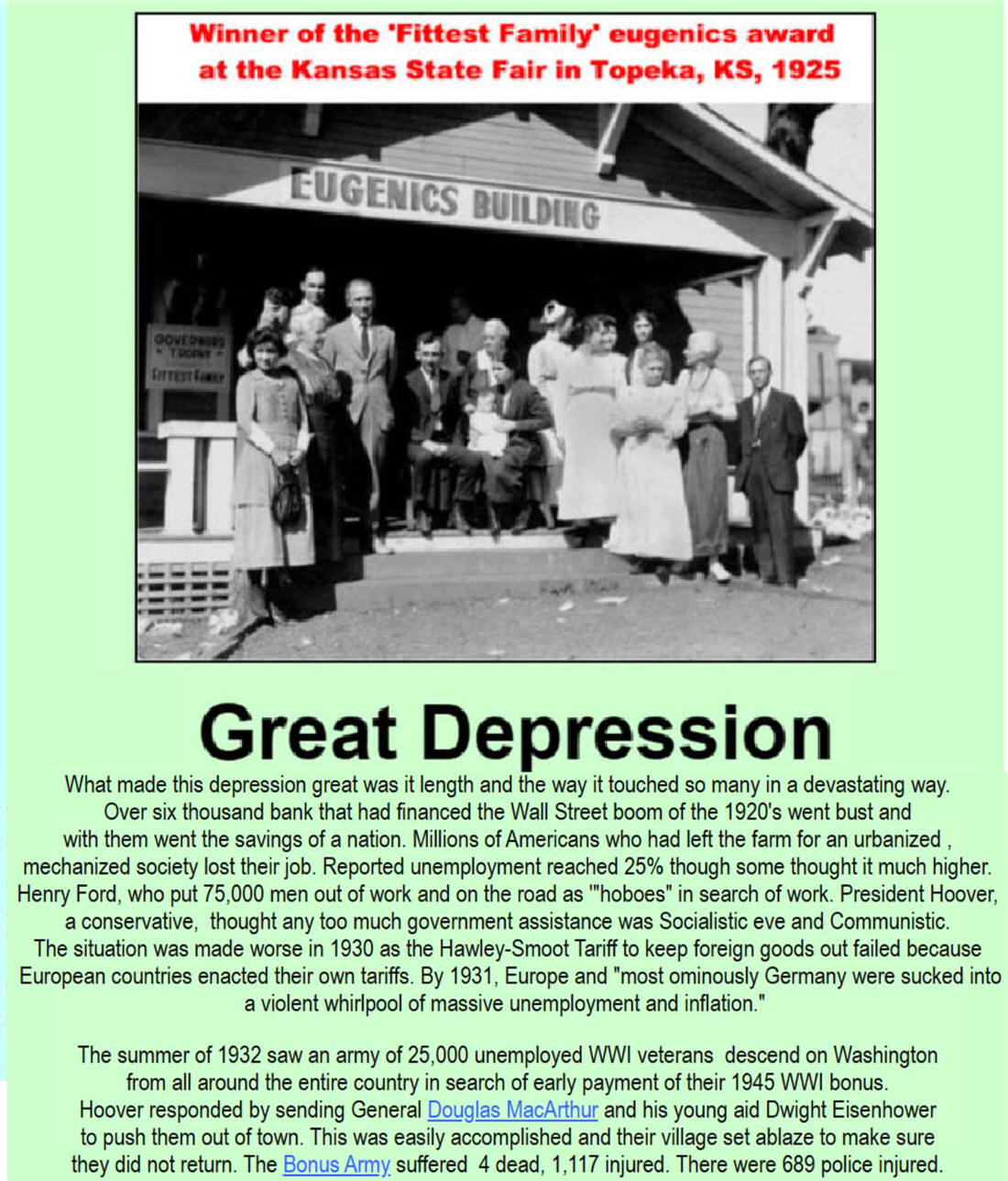
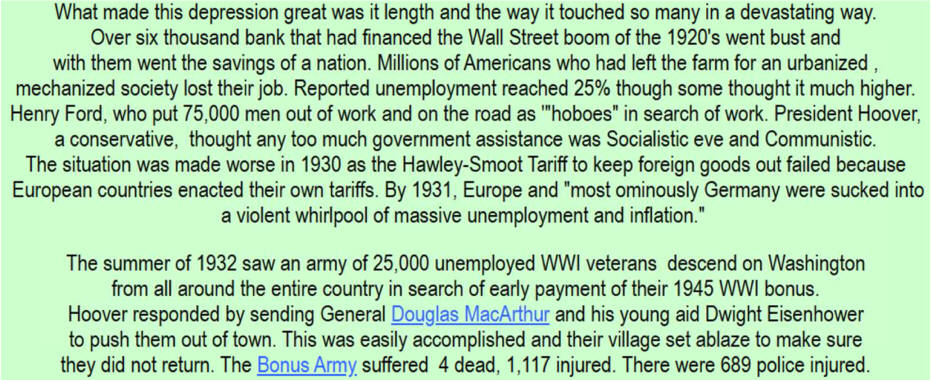
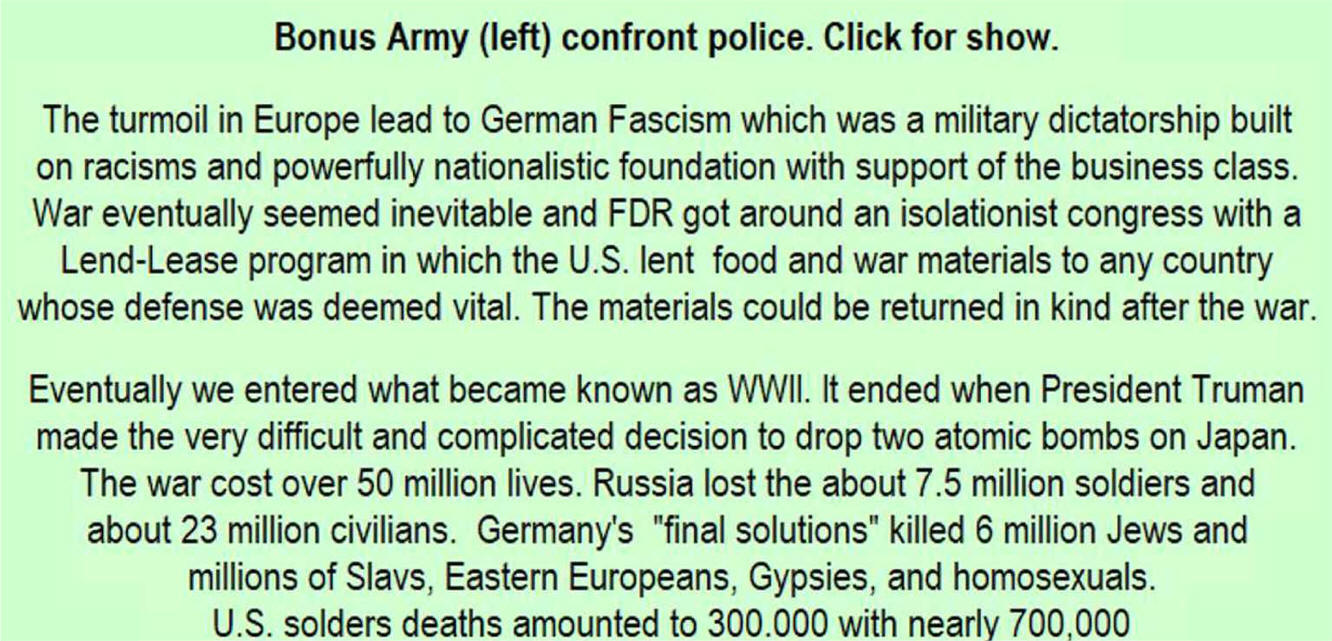
The Bonus Army suffered 4 dead, 1,117 injured. There were 689 police injured.
|
|
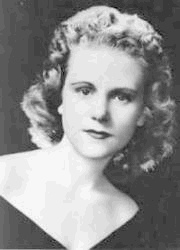
Politics Suffragists won a battle against the church, Constitution, an all male power structure, and the many women who believed women were divinely ordained a second place role. The fight began when Abigail Adams admonished her President husband John to "Remember the Ladies." The equality fight was exemplified by the many women who took part in the 10,000 worker 1860 Lynn Massachusetts shoe worker strike. Men made $3 per week while women earned one dollar. Women were also an active part of the abolitionist movement and were tired of having fewer rights than males. See Black Suffragists/19th Amendment Quaker Alice Paul had learned the art political confrontation during her British studies. She blamed the Democrats and Windrow Wilson who was against women suffrage and needed the southern male vote for his 1916 reelection. She designed a plan to support Republican candidates. In 1918 the plan worked as a Republican Congress was elected and eventually passed the Nineteenth Amendment. It was introduced by our nation's fist female congresswomen member Jeannette Rankin.
Alice Paul and Helen The July 19, 1948 Seneca Falls Women's Convention began the Women's Movement. American women followed the lead of the far more radical British women who blew up mail boxes, burned buildings, had hunger strikes, and as a result were often imprisoned. The Great War was over and America wanted a return to isolation and to get back to business. This meant three straight Republican in the White House. Warren Harding started the parade in 1921 by promising a "return to normalcy." He died in office during the Teapot Dome bribery scandal and was replaced in 1923 by Calvin Coolidge. He believed "the business of America is business." Silent Cal wanted to "stay the course." An international hero because as Commerce Secretary during WW I he had administered a food program that fed Europe. Hoover won by a landslide He was helped by a strong economy, an ever increasing stock market, and the belief by some that a vote for Roman Catholic, Democrat Al Smith was a vote for the "Pope," Economic collapse ended the Republican presidential run in 1932 when Democrat Franklin Delano Roosevelt won the election. FDR inaugural speech told the nation of his "... firm belief that the only thing we have to fear is fear itself." Roosevelt tried many remedies during his now famous first 100 days. Some economic activity returned but unemployment didn't recover until WWII 1938 economic activity. When the Supreme Court started disallowing much of his "New Deal" legislation FDR fought back by trying to pack the court. He revived an old proposal that would allow him to add a judges for existing judges over 70 years of age. The balance of power defined in the Constitution was important to the Democratic congress. It had taken five years to lose a congressional battle. |
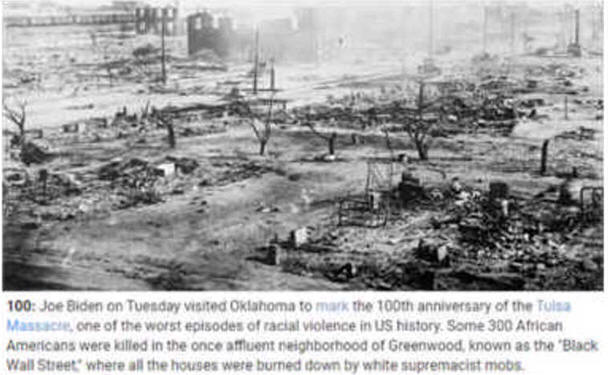
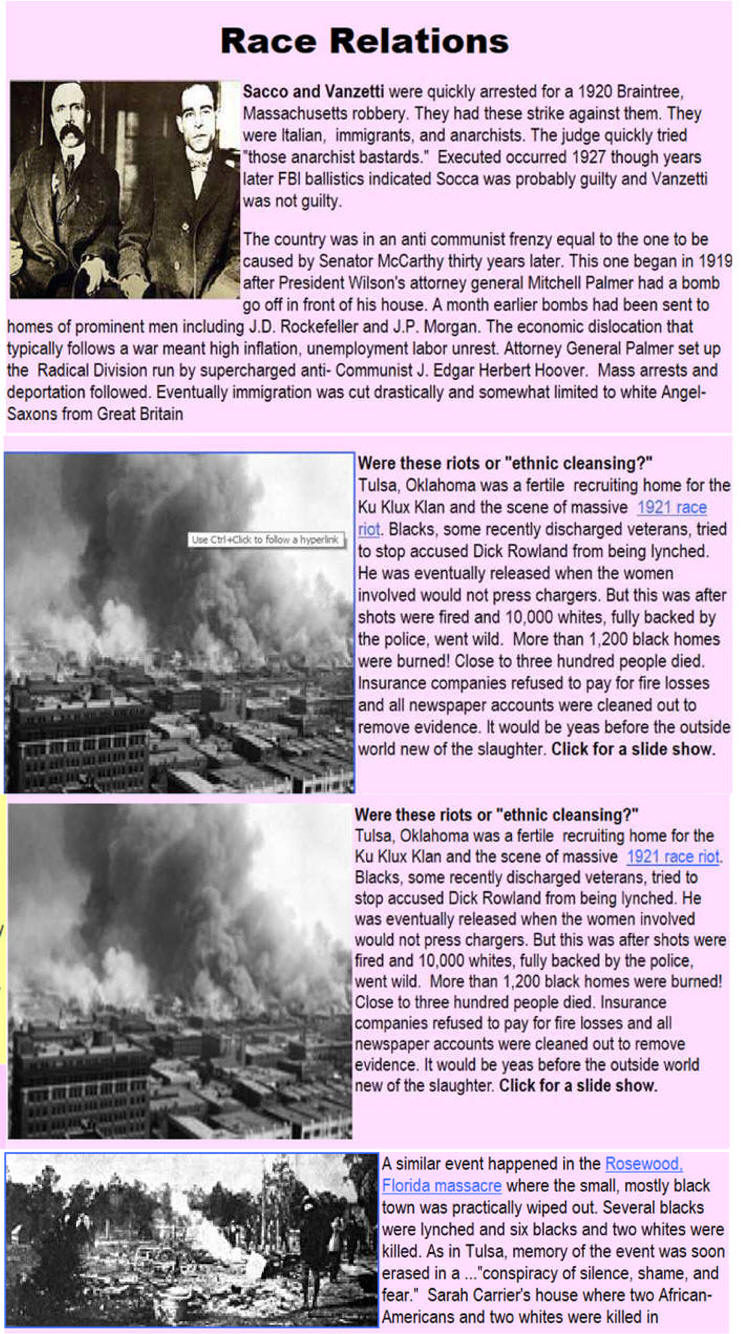
Rosewood in January 1923. Click Anxiety Caused 21st Century Populism |
|
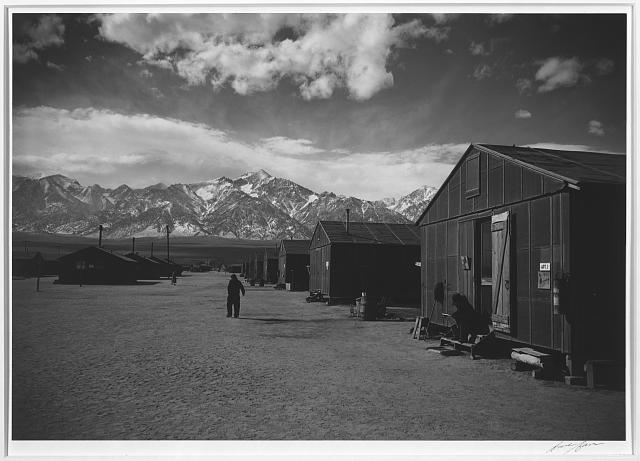
US Japanese Internment Camp WW 2
|
|
More Information 6
|
|
Current Issue 6: US, Russia, China Rivals: Rivals, Adversaries, Enemies? America's Lost International Greatness Lost Economic Greatness Please Use to Educate and Share. |
|
|
Foreign In response to an
Iron Curtin descending over Europe, the
Truman Doctrine
expressed America's belief that the
United States should support free people resisting armed minorities and other
outside pressures.
Senator Joseph McCarthy, using documents from old investigations of Communists of activity within the U.S. government, created a national furor. In 1950 he accused 205 State Department men of being part of a spy ring. Charges proved unfounded but the press was willing to listen and publicize his hearings. Americans were willing to believe his accusations that Communists were everywhere.  Joseph N. Welch (left) being questioned by Senator McCarthy, June 9, 1954. Lasting almost four years, McCarthyism came to an end when he attacked Army officers as Communists. President Eisenhower and news commentator Edward R Morrow (See It Now television) fought back. The senator came undone during televised hearing. He spiraled downward after the hearings and his 1957 death was caused by alcohol related health issue. Eisenhower administration used the CIA (headed by Allen Dulles with a plan organized by Teddy Roosevelt's grandson Kermit Roosevelt ) to help Great Britain kept control of Iranian oil as the to engineer a coup to put a shah into power. Allen Dulles later resigned rather then participate in a plan to overthrow Egypt's Nasser.
|
War Armed and trained by the Soviets, 90,000 North Koreans solders wanting
Korean unification/ They attacked American sponsored South Korea in June of 1950.
Defended by the United Nations in an attempt to stop what many thought was a
world-wide Communist conspiracy.
Hundreds of thousands of South Koreans fled south in mid-1950 after the North Korean army invaded. NATO troops were being beaten badly in a place very few people Americans knew about. But, President Truman and WWII hero General Macarthur said it was the right thing to do and that was good enough for most Americans. Led by General Douglas MacArthur and a "China lobby " of senators and media moguls like Henry Luce, the war hawks wanted an all out war against Communism including Mao's China. President Truman did not war and eventually was forced to fire zealous presidential hopeful MacArthur.
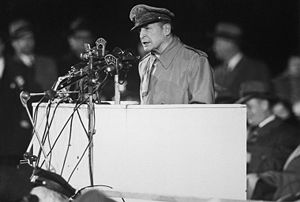
MacArthur speaking at
New President Eisenhower also did not want a larger war and it he quickly ended. The three plus year attack was eventually thrown back. Two million Koreans lost their lives as did the over 500,000 defenders (54,000 American.)
Eisenhower in Korea
with General Chung
Il-kwon, Total civilians killed/wounded:
South Korea: 990,968 causalities
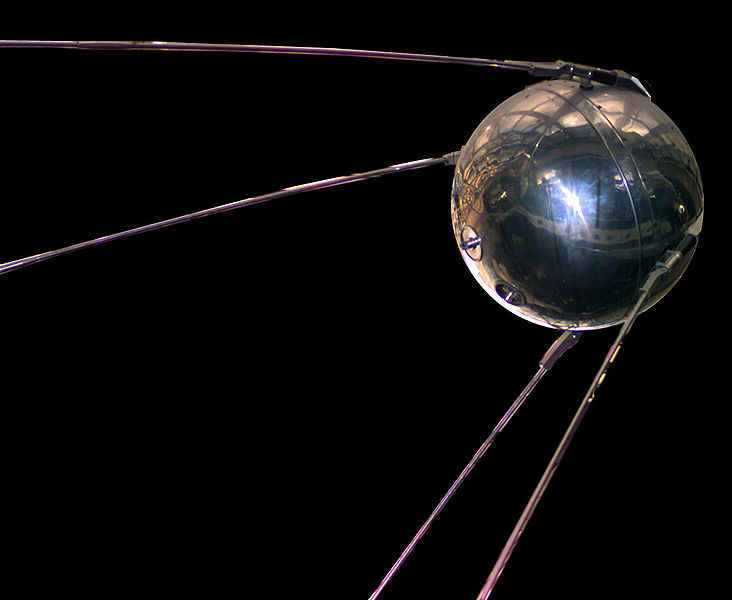
The 1957 launching by Russia of the worlds first artificial satellite Sputnik expanded the cold war into space and science education.
|
Race Relations
In
Brown vs.
Board of Education
he No. 2857 bus on which Parks was riding before her arrest is now a museum exhibit at the Henry Ford Museum.
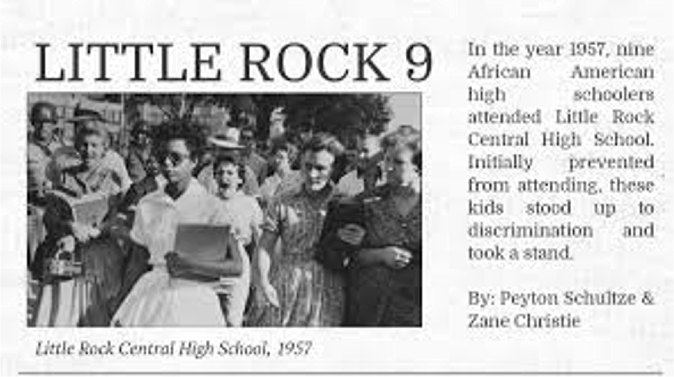
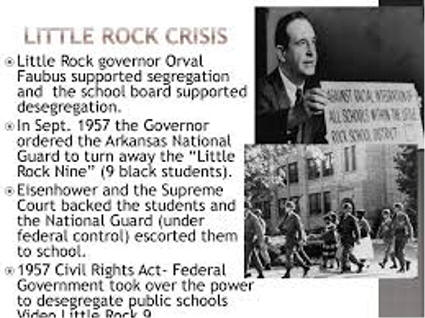
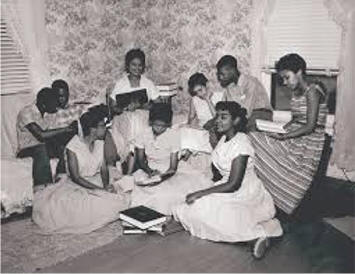
Federal Troops ordered to Arkansas in 1957 by President Eisenhower to enforce school integration for the Little Rock Nine.
The "Little Rock Nine" are escorted inside Little Rock Central High School by troops of the 101st Airborne Division of the United States Army. Click
|
|
U.S. Russia, China, |
|
Current Issue 7
|
|
8. Camelot, Vietnam, and Race Riots |
|
|
American Culture The 1960's decade "...has come down to us as 'the sixties,' a romantic fantasy..." It came from a media that had created a Camelot Whitehouse and an Age of Aquarius vocalized by popular singing group The Fifth Dimension. Click to enlarge.
But the age that began with the sale of the controversial and sometimes confrontational birth control pill had a much darker side. "Riots and long, hot summers. Assassinations. Rock-star obituaries etched in acid. A war only a 'military-industrial complex' could love."...it was an extraordinary era in which all the accepted orthodoxies of government, church, and society were called into question." Following in the footsteps of books like Uncle Tom's Cabin (1850), The Jungle (1906), and Sexual Behavior in the Human Male known as the Kinsey Reports; The Feminine Mystique (1963) "... delivered a karate chop to the American perception of reality. Betty Friedan, a summa cum laude Smith graduate described the problem without a name that faced upper middle class women. They were being systematically barred from becoming anything more than a housewife and mother by society's institutions (governments, mass media and advertising, medicine and psychiatry, education, and organized religion)." Friedman's book helped to jump-start a stalled women's rights movement. |
Politics
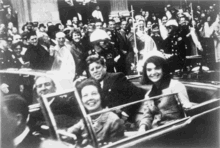
One result of President Kennedy's " ask what you can do for your country" statement was the Peace Corps but this idealism masked a continuing U.S. policy of obsessive anti-Communism, especially about Cuba. Dominance began with the 1897 Spanish-American War. The victory was glorified by Teddy Roosevelt's charge up San Wan Hill. The win brought Cuba's sugar, mining, cattle, and oil wealth almost entirely under American control. The Cuban Project was developed during the waning days of the Eisenhower administration. It was aimed at overthrowing and if necessary assassinating Fidel Castro. Cuban revolutionaries were to be supported by CIA planted insurgents who were to blow up bridges and knock out radio stations. Also American war planes were to control the air. The CIA hoped these events would set off a popular revolt against Castro. Recently elected President Kennedy decided no Americans would take part thus disarming air protection for the U.S. trained forces. The brigade of 1,400 Cubans landed at the Bay of Pigs on April 17,1961. Castro's Cuba reacted much better on all fronts and the result was a disasters for American Foreign Policy. Cuban invaders killed were 114. The rest were imprisoned and then freed by President Kennedy when he traded $53 million in food and medicine. The money was sourced from private donations and from companies expecting tax concessions. Prisoners totaling 1,189 were released.. Four members of the Alabama Air National Guard died during the invasion. The Bay of Pigs Cuban fiasco hurt American prestige and goodwill. "In Moscow, Kennedy was perceived as a weakling..." and Russia began arming Cuba more heavily. American spy flights saw evidence of missile sites being built. Fifteen tense days resulted after President Kennedy demanded the sites be disbanded. U.S. military, supported by Vice President Johnson wanted to invade Cuba but this reminded Bobby Kennedy too much of what the Japan's sneak attack at Pearl Harbor. Instead of invading the President ordered a Cuban navel blockade. Papers released many years later revealed that Russian Premier Khrushchev planned a nuclear response to a U.S. invasion of Cuba. Editor's editions in red. President Kennedy"...went Texas in the fall of 1963 to shore up southern political support for his upcoming 1964 reelection bid..." "A few months before, the good folks of Dallas had spat on Adlai Stevenson, JFK's UN Ambassador. " Three shots rang out. The President died quickly and Lyndon B. Johnson became president. |
|
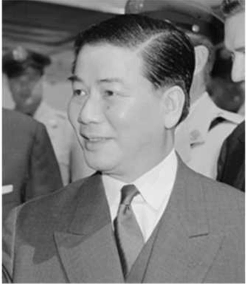
War Massive retaliation military philosophy which limited action to large retaliation was replaced by Flexible response which advocated small local US military involvements. The French left Indonesia in 1954 with a partitioned Vietnam ready for civil war. Heightened tensions cause by the construction of the Berlin Wall made holding Vietnam a requirement to maintain US creditability. By 1963 US military advisors numbered 15,000. Money and materials to support the anti-communist Saigon government were also being provided. In November a CIA fostered a coup toppled and then executed Prime Minister Ngo Dinh Diem.
Ngô Dinh Diệm after being shot and killed in the 1963 coup. CIA trained South Vietnam guerrillas attacked the North in 1964 but failed to undermine their military strength. The mode of attack was shifted to the Gulf of Tonkin where hit-and-run operations by small torpedo boats supported by warships had been initiated. Radar blips observed at one destroyer resulted in return fire and torpedo blips observe at a second destroyer also brought return fire. Confirmation was not made for either attack though the radar blips were later attributed to weather conditions. History indicate that President Johnson knew of the dubious nature of the reports. But having been given authority by the Joint Congressional Gulf of Tonkin Resolution, he ordered air retaliation attacks on North Vietnam. The war was on but not to be declared!
Downed pilot Everett Alvarez, Jr. was the first American POW. He was imprisoned for eight years. President Johnson successfully blunted Republican candidate Goldwater's accusations that he was "timid before Communism" and easily won reelection. Johnson's Daisy television campaign ad indicated Goldwater was too quick to use the bomb helped win the election. |
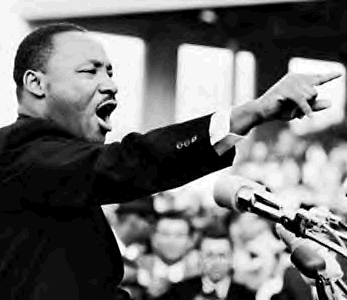
Integration and Law The 1989 film Mississippi Burning depicted a1964 effort by two FBI agents to learn about the murder of three black men at the hands of the Ku Klux Klan. It got everything wrong except the murders. "Pressured by Attorney General Robert F. Kennedy, FBI's J. Edgar Hoover sent a large contingent of agents to Mississippi but they learned nothing." A $300,000 reward brought the location of the three bodies. Twenty-one men including the police chief and his deputy were indicted. A local court dismissed the confessions of two Klansmen as unfounded information. Conspiracy charges were later brought by the Justice Department. The indicted were tried before a judge that had once compared blacks to chimpanzees. Seven of the accused were nevertheless convicted and sentenced to jail terms ranging from three to ten years. The civil rights movement had coalesced behind Martin Luther King Jr. and together with the Southern Christian Leaders Association, "... some gains through the courts and legislation..." had moved civil rights "...to the back burner." By 1963 America's attitude began to change when President Kennedy was assassinated and Civil rights leader Medgar Evers was gunned down in Mississippi. Then there was a Birmingham, Alabama church bombing that killed four little girls. Then three black men were murdered in Mississippi during the summer of 1964 and then in 1965 Malcolm was assassinated.
Housewife and mother of 5 children and a history of local activism Viola Liuzzo
heeded the
civil rights call
and traveled in March of 1965 from Michigan to Selma, Alabama. During
an FBI protected Civil Rights march she
was shot and murdered from a car containing Klansman of whom one was an FBI informer.
Martin Luther King, Jr. was shot dead in Memphis on February 29, 1968.
|
|
American |
Politics 2 |
War 2 |
Integration
|
|
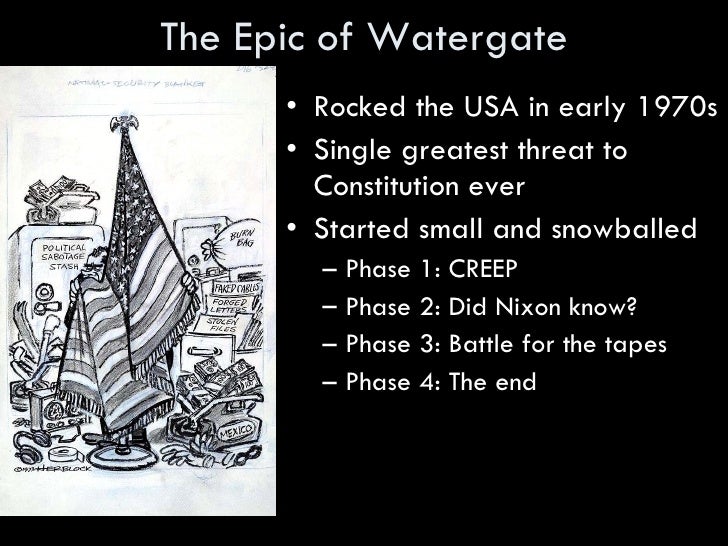
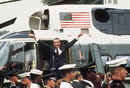
"The seventies got under way with the downfall of a corrupt
Whitehouse ..." when a sinkhole called the
Watergate scandal
singled the beginning of a change in
American's political landscape. It began a feeling of government mistrust
and aimlessness.
President Nixon giving a televised
address explaining release of edited transcripts of the tapes on April
29, 1974 As if Watergate and the Cold War were not enough, the oil cartel OPEC had the unity to succeeded with a 1973-74 oil embargo. The embargo was targeted at nations perceived as supporting Israel during the recent Yom Kippur War. Trouble was brewing.
International terrorists struck with impunity. The U.S. supported Shaw of Iran and riots end with the Iran hostage crisis which involved Americans imprisoned in America's Teheran embassy. The Iranian Revolution put an end to a decade of catastrophes.
Hostage Barry Rosen, the press attaché, age 34. The man on the right holding the briefcase is alleged by some former hostages to be future Iranian president Mahmud Ahmandinejad, although he, Iran's government and even the CIA denies this.
The Shah of Iran (left) meeting with members of the U.S. government: Alfred Atherton, William Sullivan, Cyrus Vance, Jimmy Carter, and Zbigniew Brzezinski, 1977 Click
Ayatollah
Khomeini at Neauphle-le Chateau surrounded by journalists "America suffered the indignity of its massive power in a seeming decline."
|
What became known as the
Pentagon Papers
began to appear in the June 18, 1971
NY Times. They depicted thirty-years of government deceit and ineptitude
concerning U.S. Vietnam War activities. President Kenney had ordered
defense secretary Robert McNamara to make this historical study. A large
team of scholars and analysts, one of whom was Rand Corporation analyst
Daniel Ellsberg, gathered the information . "Working at MIT after
his resignation from Rand... "...Ellsberg decided to go public
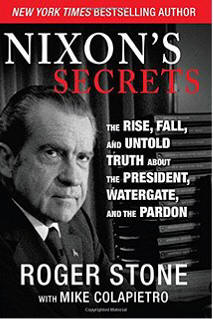
with the information." Because the information reported was before the Nixon years, the White House was at first muted about the news release. The administration's attitude changed when it realized there were other highly classified secret documents to be protected. The administration threatened the Times with espionage charges. These were ignored and a court injunction stopping publication was ordered. Based on the First Amendment, the Supreme Court ruled 6-3 in favor of the newspaper. A White House group called the ' "plumbers" ' was formed to stop news leaks. Led by former CIA employee E. Howard Hunt and ex-FBI agent G. Gordon Liddy, the goal was to use their special clandestine talents to limit anti-administration activities. One of their first tasks was a marginally successful break-in at the office of Daniel Ellsberg's psychiatrist. Some were angry because security credibility and thus intelligence operations had been damaged. From another prospective the antiwar movement gained new strength. Either way, the Pentagon papers reinforced the "bunker mentality" among the "palace guard." Watergate was much more than the third-rate burglary Nixon's press Secretary Ron Zeigler described. It was larceny was only a tiny strand in the web of domestic spying, criminal acts, illegal campaign funds, enemies lists, and obstruction of justice that emerged from the darkness as Watergate. See Nixon's Worst Betrayal President Nixon giving a televised address explaining release of edited transcripts of the tapes on April 29, 1974
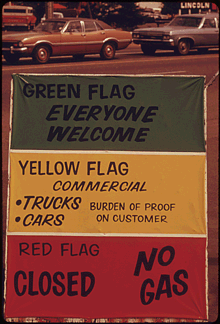
Israel has long occupied a singular, untouchable position in American foreign policy. American felt a kinship to Israel and her pro-western democracy. She was a reliable "client-state" in unstable Arab lands. Made strong by hard work and U.S. aid, she had won the Six-Day War of 1967 and the 1973 Yom kipper War. Arabs tried to get back lost lands from the 1967 war by cutting off oil shipments to the West. But the OPEC lacked the necessary economic clout until 1973 when an oil boycott succeeded in increasing the price of oil from $3 to $12 per barrel. The high oil prices caused mayhem in the United States where gas was rationed and speed limits lowered. To lower demand for oil environmental standards were relaxed and gas mileage targets set for automobiles. The result was historically high inflation and unemployment hit its highest level since the Depression. Then in 1978 the Shah of Iran's military dictatorship that had been set up by a 1954 CIA and British backed coup was overthrown during the very beginning of a fundamentalist Islamic revolution. It was led by the Ayatollah Khomeini. Gas exports to the U.S. were stopped. U.S. Embassy Hostages were taken.
Matters were made worse
by a nuclear radiation spill at the
Three Mile
Island nuclear plant. Nuclear development was then curtailed and the oil cartel OPEC
again raised oil prices. |
Vietnam
War Opposition continued even during the four-year pullout in which 20,000 US soldiers
died. Nixon and Kissinger had decided US credibility was worth
the cost.
Protests against the war in Washington, D.C. on 24 April 1971 A suspected stronghold for the Vietcong at My Lai, Vietnam was the March 16,1968 target of Charlie Company. Lieutenant Calley was ordered to "clean the village out." Charlie company had seen little action in the last three months though there had been about 100 casualties from sniper fire and booby traps. Many were frustrates from fighting a war where no uniforms separated good gooks from bad gooks. Only old men, women and children were found. On this day such civilians were herded into the center of their village and Calley ordered them shot. Three to five hundred mostly women and children were slaughtered at the My Lai Massacre. Four officers were court-martialed. Only Calley was found guilty for the murder of twenty-two villagers. President Nixon reduced Calley's sentence to house arrest. Public opinion of Calley being a scapegoat resulted his later being paroled. Later as a prosperous businessman he refused comments for a 1989 documentary. It has now been well documented that My Lai was not the only crimes against civilians in Vietnam where twice the total bomb tonnage was dropped as compared to WWII. Agent orange and other chemical defoliates were also used. War supporters on the right thought My Lai was an
aberration and Calley a victim of a leftist antiwar movement. War opponents
felt Calley and My Lai epitomized the war's immorality
and injustice.
Vietnamese women and children in Mỹ Lai before being killed in the massacre, March 16, 1968.[13] According to court testimony, they were killed seconds after the photo was taken.[14] The Fall of Saigon signified what would be the first war lost in US history.
Victorious NVA troops at the Presidential Palace, Saigon. |
Integration
Continues
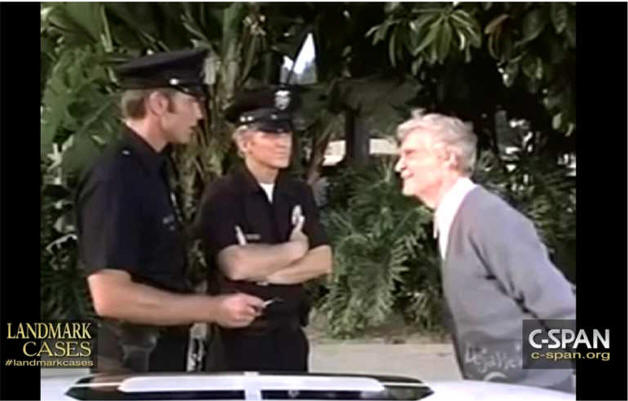
Schools with 90+ percent black students dropped, especially in the South where home schooling and Christian schools would became popular. Red added by editor. High school dropout with a criminal record from his teen years Ernesto Miranda was convicted of kidnapping and raping a teenage girl. He had signed a confession stating he had been read his rights but his court-appointed attorney argued that Ernesto had not been told of his right to legal council. A 1966 Chief Justice Warren Court ruled 5-4 that his Fifth Amendment protection against self-incrimination had been violated. To some it was a great milestone for civil liberty while others felt it was the beginning of civilization's end.
Ernesto Arturo Miranda was a laborer whose
conviction on kidnapping, rape, and armed robbery charges based on
his confession under police interrogation was set aside in the
landmark U.S. Supreme Court ... Wikipedia
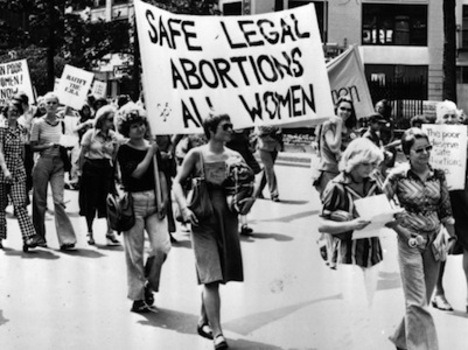
Based on new evidence Ernesto was later convicted and served time. He was paroled and died from a knife induced wound incurred during a 1976 bar fight. The seven to two 1973 Supreme Court ruling in Roe v. Wade prohibited state abortion limits during the first term (three months). It also limited prohibitions the states may make during the second term. For some, it was a matter of private choice (pro-choice), to others it was government-sanctioned murder (pro-life).
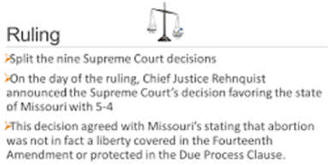
President Reagan's appointees made the court more conservative and by a five to four vote the 1989 in the Webster v Reproductive Health Service case the court expanded state authority to limit abortions. For more see cnn.Reagan.courts.
The Battle Continues
Protestors at the 2009 March for Life rally against Roe v. Wade
|
|
More
Information 8
Please Use to Educate and Share.
|
|||
|
Current Issues
U. S. Wellbeing: The Good and the Bad
6.
Debt 7.
Government
8.
Civility 9.
The Bottom Line |
|||
|
American Culture |
Foreign Affairs Politics |
War |
Economy |
|
To many the Reagan era brought a
brake from the sour mood caused by Vietnam and Watergate. "Wall
Street was tottering through another of its periodic scandals, --
this time it was over their manipulating junk bonds. A banking crisis
would cost taxpayers billions", and Crake cocaine was the rage. Still,
confidence had returned. "Gender Gap tensions rose higher when law professor Anita Hill charged that President Bush's Supreme Court nominee Clarence Thomas..." had sexually harassed her when she was his assistant.
Reports of Bill Clinton's womanizing surfaced during his nomination campaign. Womanizing followed him to the Whitehouse as his relationship with Monica Lewinsky resulted in a January of 1997 impeachment trial. Click
Monica Lewinsky when she was a White House Intern Watch
The Price of Shame
|
George Bush 1988 win made him first sitting vice president elected
on his own right since Martin Van Buren's 1836 election . Bush was given a
Martin Van Buren portrait on Inauguration Day though the fact that Martin
lost reelection because of a terrible economy was probably not mentioned.
"Running as an "agent of change" who promised reforms, "Bubba Clinton" became the first "baby boomer" president." in 1992. His campaign was aided by the indelible image of President Bush looking at his watch during the third TV debate. Also right before the election questions about President Bush's role in the Iran-Contra affair were back in the headlines. Third party conservative candidate millionaire Ross Perot, capturing 19 percent of the vote. Bush lost by 6 percentage points. A Pentagon Chainsaw Massacre over Clinton's attempt to overturn the ban on gays in the military cause him to accept don't ask, don't tell. This ended his very short honeymoon. Many small problems seemed to eclipse his major successes of the NAFTA free trade agreement, hand gun control legislation known as the Brady Bill, and a 1993 tax bill containing tough deficit reduction restrictions. The health care lobby had caused a sharp rebuttal to the President's centerpiece health care legislation and created problems for the1994 midterm election. As a result, the Republican gained control of the House of Representatives. They were led by Georgia Representative Newt Gingrich who trumpeted a conservative list of promises entitled the Contract with America. Advised by his pollsters, President Clinton dealt with the mid term election losses by moving toward the center. His budget battles with Republicans lead to a shut down of the government and Clinton came out the winner. His support for a major overhaul of the welfare system also helped with his battle with conservatives. Election day 2000 saw a liberal
sitting vice president Al Gore whose team had defeated Bush I in 1982 facing
conservative Bush II . "Those who cast the votes decide nothing. Those
who count the votes decide everything" 'is a quote attributed to Joseph
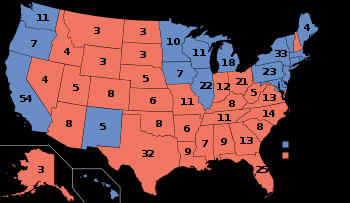
Stalin. On the day after voting the presidential election hung on Florida's
twenty five electoral votes. Lawyers, the Florida Supreme Court, and the
U.S. Supreme Court got involve and on December 12 the high court made a
decision that gave the election to Bush II. Third
party candidate Ralph Nader running for the liberal Green Party received
1.63% of the votes which added to Gore's 48.84% gave him more than 48.85%
received by Bush II.
|
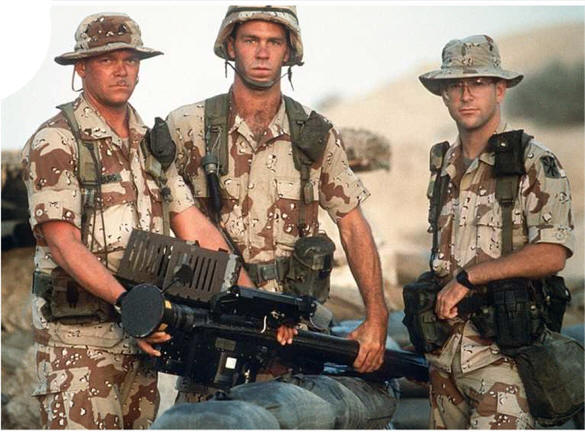
" Saddam Hussein's August of 1990 invasion of neighboring oil-rich Kuwait..." added George Bush to the list of post WWII presidents confounded by Middle East problems. The United Nations was mobilized under Operation Desert Storm and a thirty-nine nation coalition went to work. A devastating air war followed by a very short 100 hour ground offensive did the trick. An Iraqi win would have given them control over 40% of the world's oil supply.
U.S. Army soldiers from
the
Kuwait
Click to enlarge most pictures.
Donald Rumsfeld as U.S. special envoy to the Middle East, meets Saddam Hussein on 19–20 December 1983. |
Economics, also known as the dismal
science, holds growth is good but too much growth can cause inflation.
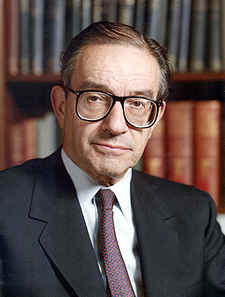
Alan Greenspan's phrase "
irrational
exuberance" to describe a 1996 stock market he feared might be too
high sent tremors through the global economy. When setting policy, the Federal Reserve must balance sustainable growth and maximum employment. "Policies can ultimately determine the cost of home mortgages or car loans, the profits that support corporate survival and the stock marketing, or even, potentially, who is the next president."
Ruby Ridge Ruby Ridge , Idaho was the 1992 scene of a confrontation between the family of "self-proclaimed Christian separatist Randall Weaver and the FBI." Too many people were killed on both sides.
Waco Ridge Texas1993
siege was the scene of a Branch Davidian religious sect
confrontation with the federal government. Their leader David Koresh had
accumulating many guns. Too many people were
killed on both sides. The "By 1999, a majority of the public believed that the FBI had murdered innocent people at Waco... and Ruby Ridge." On the second anniversary of the Waco disaster the Oklahoma City truck bomb explosion at a federal government building killed 168 people. Click Unabomber of 1978-1998, targeting science and engineering professors. He struck sixteen times, killing three. It took seventeen years and $50 million to capture Ted Kaczynski. Olympic Park was the scene of a pipe bomb explosion killing two people. It was one of four bombings committed by Eric Robert Rudolph
|
|
10. Trump's New Political Era? Revised for phones and classrooms Source Steve LeVine Oct 1 Summary from author/editor Walter Antoniotti |
||
|
Culture A
Trio of independent cultural disruptions
A Trio of independent cultural disruptions America's 1990 dissatisfaction with disruptions spread to Europe causing two years of volatile pubic fury. This spread compounds to an unpredictable degree the possible disruption to Europe and Western Culture.
Status and Social Cultural Apprehensions
An end to
a post WWII US led moderation
All three disruptions could last years Optimistic leaders thought and even hoped Trump, Brexit, or something else would help moderate our disruptions. Disruption modification related to Trump, and Brexit, power immigrants are difficult.
1. No
opposing stability force seems forthcoming Recent Supreme Court Jurisprudence. 2 000 Bush v. Gore: installed their preferred partisan presidency stating it should not be cited as precedent.2012 NFIB v. Sebelius: blunted ObamaCare Medicaid expansion stopping Congress coerced states expansion.
2013
Shelby County v. Holder:
stop voting rule
2013
Citizens United v. FEC
near-unlimited
A New Normal Era for political economy on World Economic
Control?
Please use as
a link, |
Foreign Affairs China's Aggressive Strategic International Plan Older Plan: Hide Strengths, Bide Time Replaced
a. Xi now
has more centralized political power
a. Expanded
South China Seal Militarism f. Military exercises with Russia Editor's Note: In a liberal Democracy, this is often done by business expansion. In 2017 U.S. Invested > $100 billion in China alone. Source U.S. - China Relations, North Korea & the Future of the Global Order Well Conceived Grand Strategy a) Based on a clearly defined policy purposes b) Think a situation through, observe in detail and in relation to underlying historical trends c) Set a new Recent Changes a) Enhanced role of Communist Party and Ideology to counter China's lethargic corrupt state bureaucracy 1. Enhanced CPC authority by replacing state control of Foreign Diplomacy with party controlled Foreign Relations Power 2. Marxian, Nationalistic, Authoritarian model of capitalism compete with liberal democracy, 3. Xi concept of future world community, mechanistic attempt to invigorate diplomatic community to be more creative and use of theory over policy 4. New State Diplomacy enhances State Capitalism, pragmatism is gone, national interest enhanced by a national vision b. Ideological Confidence increased because history now favors Chinas according to Marxian dialectic analysis 1) Nothing random about what is unfolding, it is the result of the immutable laws of economic development Based on Marxian Dialectic Turning Point indicated by relative decline of US/West and China's rise. 2) Current historical juncture represents a strategic opportunity for China 3) How a one-party state ideate using political topic/lingua franca is important c) More Sharply Focused Chinese Diplomacy d) China to Lead Improve Global Government Reform 1. In 2014, Xi saw an impending struggle for the future o f International Global Order 2. China must now control the reform of international order a. organization like UN, WTO ... b. US system of global alliance to ensure her own definition international security 3. Change U.S. Control Global Governess now based on a complex web of world organizations using international based treaty law and shared sovereignty 4. Global Governance Improvement 5. Reasons for success a. Diplomacy based on Chinese Socialism will lead to more fairness and justice b. US Ignoring World Order, Paris Climate Accord, UN Refuge System, WTO 6. Controlling international institutions is first step e) Is China Backing off a bit as Worlds, especially US, reacts |
Cultural Wars
Neoliberal globalization four processes: 2) de-regulation 3) privatization 4) upward re-distribution of wealth Together they have increased economic insecurity and cultural anxiety by 1) the creation of surplus peoples 2) rising global inequality 3) threats to identity. Anxiety from neoliberal globalization has armed right and left populists. Neither Norris and Inglehart nor Laclau adequately account for such insecurity in their ordination of populism. “the people” are differentially deployed by right and left and they themselves must be understood in terms of the respective enemies through which “the people” is constructed, a decisive dimension of populism. Neo Liberal's Caused Financial Collapse
Neoliberal Economic
Orthodoxies wrong,
B. Dollar investments dependent on high Intellectual
Property generated corporate profits
and U.S. economic growth. C. Distribution of these profits has resulted into an increase inequality of income. D. The disruption of this process, called the Trump astric, has many academics apprehensive
E. Source
The New Financial
Geopolitics-
Development of
Illiberal
Democracy Understanding Right and Left Populism
Right populism
defines "the people"
Left populism defines “the people”
as
social structures/institutions |
|
Prelude: Chinas Emerging Political System |
China's Strategic Plan Response China's Korean Peninsula Policy |
|
|
Panorama of American History
Presidents
Analysis
Quick
Books Complete Collection |
|
Current Issue
A New
Political Economy Normal
Depends on World Economic Control? Saving Liberal Democracy from the Extremes, by the FT's Martin Wolf Adjusting to the China Shock pdf Please use as a link, as textbooks/supplements, and
|










![Iran, history of: Iranian hostage crisis [Credit: AP]](http://media-2.web.britannica.com/eb-media/92/550x409x158492-004-0CD8202C.jpg.pagespeed.ic.B8cSOS2ZBI.jpg)